
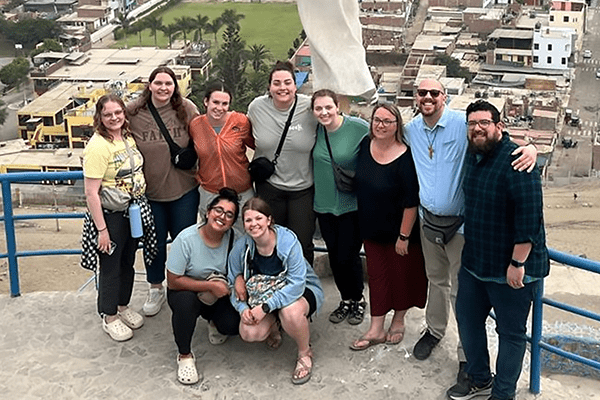
Viterbo students and staff at Casa Hogar in 2024. On the far right is Dcn. Emilio Alvarez, Director of Campus Ministry. (Submitted photo)
Submitted By VITERBO UNIVERSITY
After speaking to others in campus ministry about the spring-break service immersion trip to Casa Hogar Juan Pablo II in Peru, Viterbo University student Alessia Eckelaert thought it would be great opportunity for her to get out in the world and do some good.
“It turned out even better than I’d hoped,” said Eckelaert, a senior nutrition and dietetics major from Sheboygan. “I went with a fantastic group and everyone we met was so service-orientated and wanted to make life better for the kids at Casa Hogar. Getting to be a part of that was truly very special.”
Founded by Fr. Joe Walijewski in 1986 and sponsored by the Diocese of La Crosse, Casa Hogar is home to 64 youth ages five to 17, many of whom are orphans and all survivors of extreme poverty. The young people are divided into eight “families” by age, and each family is led by a volunteer couple called teachers. The goal is to provide the youth with safety, security, education and a family atmosphere in which they can develop into good and strong people with the skills to lift themselves and their families out of poverty.
Eckelaert was one of 11 Viterbo students and four staff members to make the 4,000-mile, 10-day trip to Lurin (just south of Lima). Her favorite part was walking the stations of the cross up the hill to the grave of Fr. Walijewski. “We went up just as the sun was setting, holding the kids’ hands and praying the rosary,” Eckelaert said. “It was such a beautiful moment.”
This was the fourth annual service immersion trip for Viterbo students to Casa Hogar. Participating in the trip this year was Viterbo President Rick Trietley. “We tell the students, it’s not a vacation, it’s a pilgrimage,” Trietley said. “We’re going there to work hard, serve and do missionary work.”
One highlight of that missionary work was accompanying a well-known local “angel of mercy” as she delivered powdered milk, rosaries and kind words to the poor and sick in poverty-stricken neighborhoods. The students also met with local families, taking them bread, talking and getting to know them.
“The impact of an educational and life experience like this is tremendous,” said Trietley, who noted that a Viterbo education is designed to be holistic and much more than just academics. “What’s really impressive to me is that we’ve been doing this for four years, and you can’t beat the immersion experience of hearing and speaking a different language, trying to fit in and understand the culture, and seeing the poverty as you really try get to know people on a personal level. They are glad we’re there, and our students are happy to be there as well. Some students have gone more than once, and there is a cost to go. I am so proud of our students. They could go anywhere or just go home for spring break, but they spend their own hard-earned money to serve others and take Viterbo’s mission out into the world.”
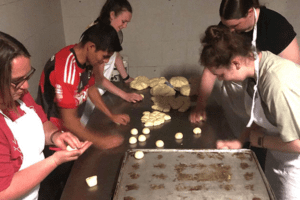
Viterbo pilgrims help make homemade bread for the residents of Casa Hogar, which is done two or three times a week in the onsite bakery. (Submitted photo)
The establishment of Viterbo’s formal relationship with Casa Hogar began with a 2022 visit by four university officials, including Director of Campus Ministry Emilio Alvarez, who went on to also become a deacon. Dcn. Alvarez has participated in each of the four trips with students.
“Service immersion is an eye-opening, perspective-shifting experience,” Dcn. Alvarez said. “They can be very formative spiritually, and participants form a bond with each other and with people across the world. It connects them with humanity, and often they come to realize the needs are great in their own back yard.”
Several students have returned for three- and six-month volunteer opportunities after graduation. Viterbo University offers a full-tuition scholarship for youth at Casa Hogar who want to earn a college degree. The first scholarship recipient, Rosa Huaman Letona, grew up at Casa Hogar and will begin her senior year at Viterbo in the fall. A social work major, she plans to return to Peru (maybe even Casa Hogar) to practice her profession after earning her degree.
Today, the executive director of Casa Hogar is Msgr. Joe Hirsch, who has served in the role for the past 13 years. Casa Hogar founder Fr. Walijewski, or Padre José as he was affectionally known in Peru, is now a candidate for sainthood, and Msgr. Hirsch served as the Promoter for Justice during the diocesan phase of the process.
“I’m just walking in the steps of Padre José,” Msgr. Hirsch said of his ministry at Casa Hogar. “We all need to have a missionary spirit and be open to the bigger
world around us.”
Msgr. Hirsch has been breaking barriers to the greater world his entire priesthood. In addition to speaking fluent Spanish and having a great understanding of Hispanic and South American culture, Msgr. Hirsch has a gift for music that helps him reach and connect with young people and others from all walks of life.
Casa Hogar hosts other groups of students in addition to the one from Viterbo for service trips each year. Participants describe it as a “phenomenal experience.”
Before departing, Msgr. Hirsch asks each to “go back home and ask yourselves, ‘what does God want of me?’”
For more information about Casa Hogar, visit the Diocese of La Crosse website at diolc.org.

Alessia Eckelaert and one of the friends she made while serving in Peru. (Submitted Photo)
