
The trend of more young Catholic men diving deeper into their faith came to faithful fruition on Oct. 19, as Archbishop Jeffrey S. Grob presided over a Mass where 41 new members of Marquette University’s Knights of Columbus Council 6883 were exemplified in the first degree.
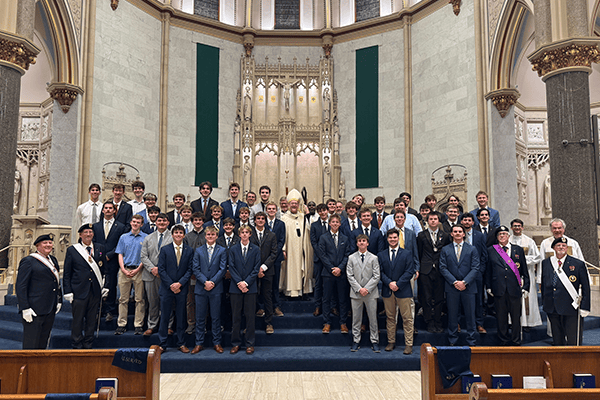
Newly received members of Marquette University’s Knights of Columbus Council 6883 gather with Archbishop Jeffrey S. Grob, honor guard members and concelebrating priests at the Church of the Gesu. (Submitted photo)
They gathered at the Church of the Gesu on the Marquette campus, where each of the 41 new men made a greater promise to a deeper commitment of faith, a kind of Catholic commitment that is seeing growth among young people like freshman Zach Cattapan.
“The Knights of Columbus, to me, just looked like a beacon of hope for being a Catholic on campus in terms of being a community of like-minded men who wanted to grow in faith, who wanted to pursue Catholicism,” said Cattapan, a business administration student who is among the three dozen who just joined the Knights.
He took part in Monday night’s Mass and the vow that was joined by more than three dozen others with the Knights chapter that was formed on campus in the 1980s.
“The men take a promise that, aided by the grace received at their Baptism, they will promote their lives as Christian gentlemen in thought, word and deed to witness to the grace of their Baptism,” said Knights Chaplain and Spiritual Advisor Fr. Michael Maher, SJ, “especially in defense of the faith and to live the faith as best they can.”
The new council members, part of a group of 90 on the Marquette campus, reflect a growing trend. The 320 college Knights councils across America now include about 37,000 members whose experience belies the stereotype that the Knights have historically carried.
“I was telling my mom I was going to join, and she said to me, ‘I thought to be in the Knights of Columbus, you had to be over 100,’” said Cattapan. “I never realized that it was a real organization that young people were getting involved with until I came to Marquette.”
“The Knights of Columbus before I joined were [perceived as] the guys who were on the road handing out Tootsie Rolls. My grandfather had a sword hanging up in his dining room. It was sort of this abstract idea of like this old school, ‘This is what faith used to mean.’ All the guys at a parish would hang out and do a faith sharing once a week,” Marquette Knights member Ronan Barron said.
“Before joining and getting really integrated into a college council, it was just an abstract idea of men who were taking their faith seriously, and you also get a cool sword out of it.”
Many of the 37,000 Knights’ college members were searching for what Grand Knight William deGuzman was looking for when he joined the group.
“When I came to Marquette, I was hungry for the idea of brotherhood, especially faith,” he said.
“I think the Knights give you a concrete way to live it out through our Masses, our rosaries, Bible studies and pilgrimages. It provides you an opportunity to have genuine friendships with other men who keep you accountable, who challenge you where you’re struggling.”
“I think so many young guys, especially in the college scene, are growing dissatisfied with the material world and things that they’ve been promised will bring them happiness,” Cattapan added. “They’re looking for something higher. They’re looking for a deeper purpose, a deeper direction in life.
“The Marquette Knights council’s four pillars involve faith, charity, unity and fraternity. Don’t be fooled by the fourth pillar, as it stands more for the unofficial term involving brotherhood and togetherness than the typical college definition of that word.”
The Knights provide you an opportunity to hang out,” deGuzman shared.
“We have bonfires, we have the Michael McGivney house (named after the founder of the Knights of Columbus), where we can just smoke a cigar, have a fire, play bags in the backyard, and then also provides you an opportunity to put your faith in action [with] charity around Milwaukee. It’s a well, well-rounded organization where a man can really dive more deeply into his faith and grow — grow others, grow closer to others, but also grow closer to God.”
Fr. Maher says that the Knights as a whole bear parallels with the story of the Jesuit university, as the Knights’ first meeting happened the year Marquette began, in 1881.
“During that time, there was tremendous anti-Catholic and anti-immigrant prejudice. Catholics were not wanted. There were signs [saying], ‘No Catholics need apply.’ And the whole Knights were founded in support of the Catholic faith,” he said.
“The Knights saw this idea that the United States would be helped by those who lived their Catholic life. Not that they tried to make everybody Catholic, but by living a moral life.”
Fr. Maher also said that while knights of old used a sword for battle, the weaponry these Knights from Marquette receive is a faith rooted alongside intellectual growth.
“How are we going to defend the Catholic faith and defend the dignity of the human person, which is at the root of all Catholic social teaching? How do we do that from the expertise we’ve learned in college?” he said.
“I think that excites young men, to look them in the eye and say, ‘We need you. We need you in the fight.’”
