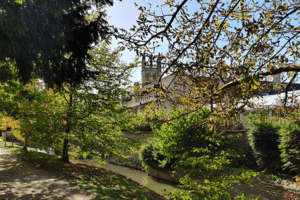
A visit to Addison’s Walk in Oxford inspires reflections on friendship, faith and the lasting influence of J.R.R. Tolkien and C.S. Lewis. (Submitted photo)
The song “The Journey to the Grey Havens” from The Return of the King soundtrack feels like a visceral embodiment of the beauty of eternity. Recently, I had the great gift of taking a sort of creativity pilgrimage to England and Ireland. During that time, among the countless wonderful things I got to do, I took the opportunity to listen to that song on my headphones in a couple of stunning locations: on the roof of St. Paul’s Cathedral in London, on Addison’s Walk in Oxford and walking around at Galway Bay.
Listening to it with the city of London spread out below me from the dome of St. Paul’s strangely turned into a reflection on justice. London is, in a way, a microcosm of human nature: on the one hand the origin point of so many destructive choices over the centuries that still have consequences in the world today, and on the other, a place woven into the lives of so many artists and saints and heroes and people who left enduring beauty and goodness in their wake.
With its complicated legacy in my mind and a song about eternity playing in my ears, I thought about justice — about the ache for all that is broken and tragic in the world to be set to rights. I thought about how we often equate justice with punishment and how that’s one tiny corner of what justice really is. Justice is things being as they should be. Things, nations, human hearts, ordered and moving in the harmony of being the way that God created them to be. I think it is also why justice and mercy can feel to us like things in conflict. Mercy is similarly a lot bigger than our common conception of letting someone off the hook. Mercy is giving better than is deserved. And one of the things that struck me up there, just below the dome of St. Paul’s, is that in our fallen world, mercy is actually a precondition to any possibility of real justice. The ways each person’s brokenness bumps up against the brokenness of others and sends out ripple effects of destruction can never be dealt with by even the most measured and complete version of our ideas of retribution.
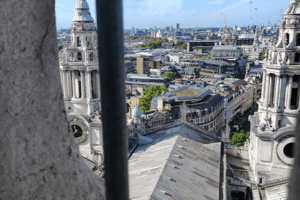
From St. Paul’s Cathedral in London, Jacinta Van Hecke reflects on the relationship between justice, mercy and hope. (Submitted photo)
Accountability, protecting victims and enforcing laws remain essential. But none of that alone can build a world where all is set right. It’s not that any of us have the strength and wisdom to build that world on our own. But mercy makes space for God to be the one to do it: to build something out of the messiness that is even more beautiful than what would have otherwise been. And looking out over London, I felt not only the ache for all that has been broken to be set right, I also felt some degree of hope that, even if it’s still so far away, it can be.
I listened to the same song on Addison’s Walk in Oxford. Addison’s Walk is a path through trees and around a meadow within the bounds of Magdalen College, and it’s where J.R.R. Tolkien and C.S. Lewis went on a walk one night and Tolkien helped Lewis convert to Christianity. I walked around and reflected on the legacy of beauty that these writers left with the world and how I don’t know who I would be without their influence on my life. The song itself was inspired by Tolkien’s work, a reminder of beauty’s far-reaching influence. But another thing that struck me was how intimate and small this particular world-changing event was. It was two friends having a conversation. I think maybe everything important happens small. Even things with the widest impact on the world start as small, relational, human moments. Our primary vocation is always to love, and love always has to happen at the scale of one person to another. Love is always fruitful, so those small and intimate choices of love will send ripple effects all through the world, but it always starts small. Most of the time, those ripples will be hidden, but occasionally we get to catch a glimpse of them — like in the fruit that was born from friendship on Addison’s Walk.

At Galway Bay in Ireland, Van Hecke finds a reminder of eternity and the promise of redemption. (Submitted photo)
And finally, Galway Bay on the western coast of Ireland, opening to the ocean, is geographically somewhat similar to the Grey Havens — the place in the Lord of the Rings from which people leave, essentially on their way to heaven. Perhaps that is why it’s a place where I feel the reality of eternity so profoundly present, even if it’s only for a moment. But for that moment, everything gets rightsized. I can feel for that moment that all of the struggles and tragedies of our life on earth can be redeemed and that becoming the kind of person who can be happy with God for all eternity is, ultimately, the only thing that matters.
Among the many experiences on my pilgrimage that I will be reflecting on for years to come, these three threads — all set to the same soundtrack song — were recurring: that justice needs to be founded on mercy, that everything important happens small and that what matters is who you become.