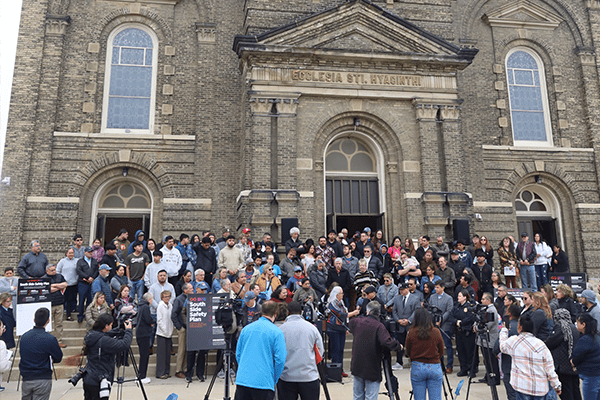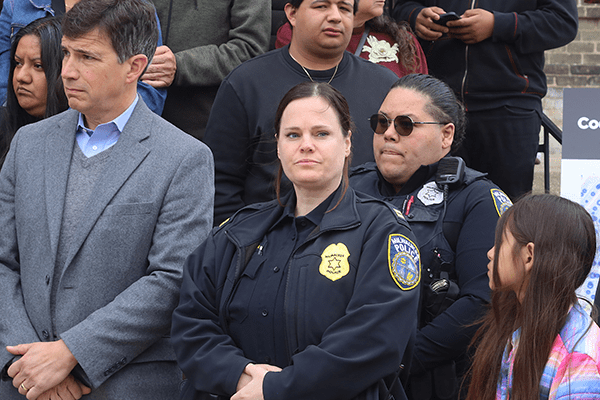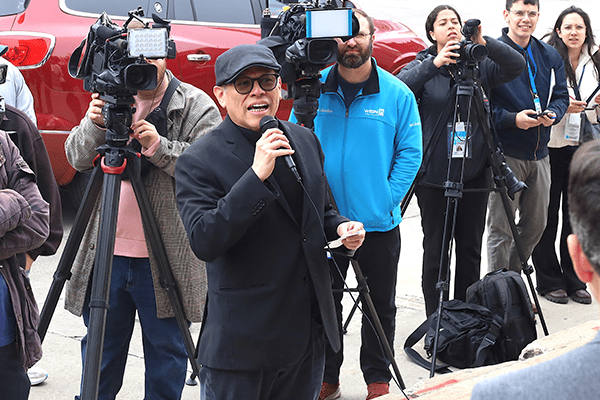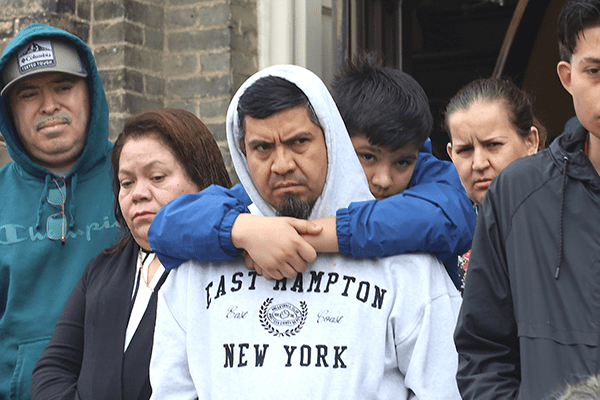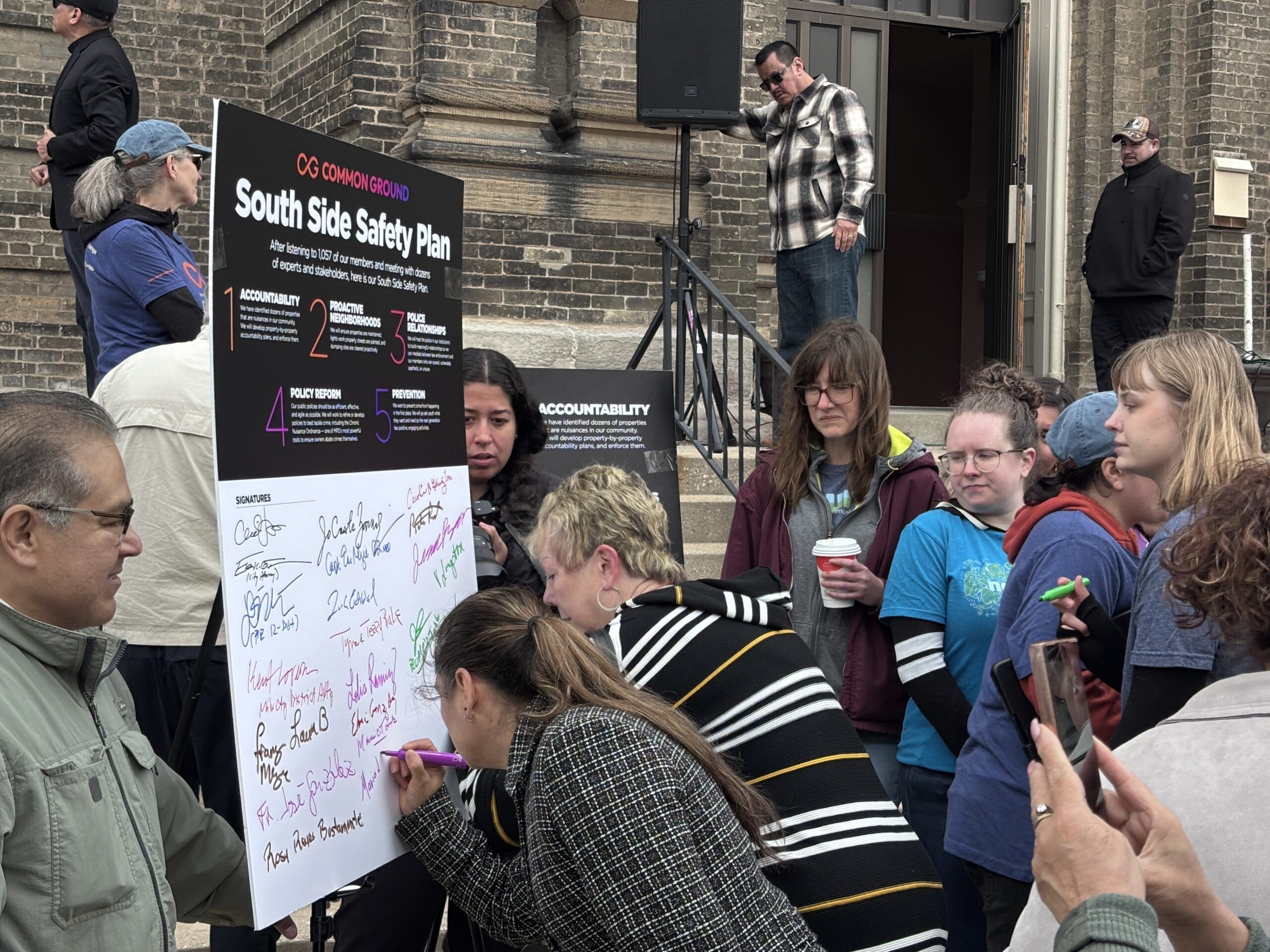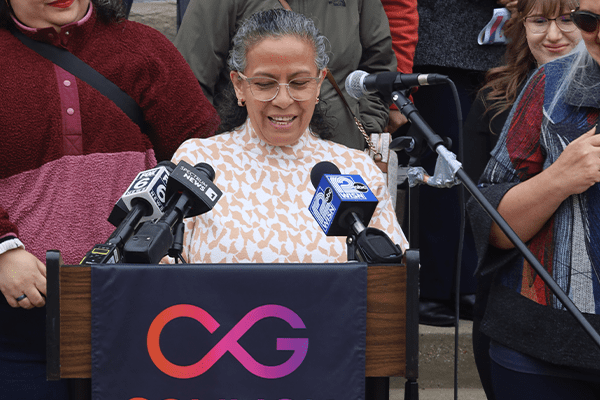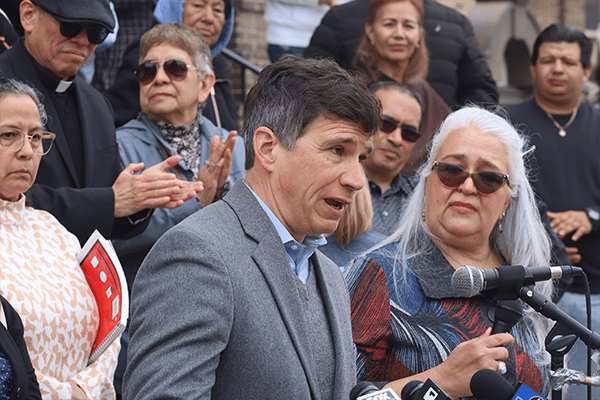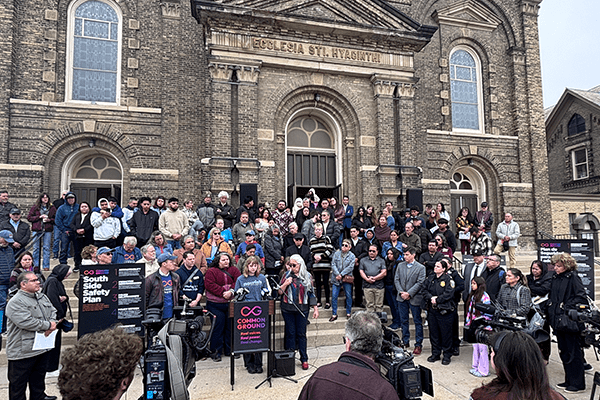
Community members and civic leaders discuss Common Ground’s South Side Safety Plan outside St. Hyacinth, Milwaukee, following an April 26 press conference unveiling the five-point initiative focused on crime prevention, neighborhood accountability and stronger police-community relationships. (Submitted photo)
Milwaukee’s St. Hyacinth Church, 1414 W. Becher St., seemed a most appropriate venue for a Common Ground press conference April 26.
After all, as Common Ground Senior Associate Organizer Kevin Solomon pointed out, the organization, although nonsectarian, has “deep Catholic roots.” Auxiliary Bishop Jeffrey Haines helped found Common Ground as a parish priest. Priests have served as board members, the organization is partially funded by the Catholic Campaign for Human Development and, in addition to St. Hyacinth, St. Adalbert Parish and St. John Paul II parish are institutional members.
The press conference featured the presentation and signing of a five-point South Side Safety Plan, six months in the making. About 150 people attended, standing on the steps and sidewalk in front of the church. The crowd was heavily Latino, reflective of the ethnic makeup of the area of the plan’s focus, approximately South 10th to South 20th Street and West Mitchell Street to West Lincoln Avenue.
Affixing their signatures to an outsize copy in solidarity with the plan were Common Ground members, as well as civic officials — Milwaukee County Supervisors Jack Eckblad and Caroline Gomez-Tom and District Attorney Kent Lovern; Milwaukee Aldermen Jose Perez and JoCasta Zamarripa and Police Captain Erin Mejia. Unable to attend, Milwaukee Mayor Cavalier Johnson and City Attorney Evan Goyke signed in advance. According to Solomon, additional officials have been signing in the aftermath of the press conference.
Solomon described Common Ground as “an alliance of 46 institutions across Greater Milwaukee. We come together to have nonpartisan power for the common good.” The organization unites community leaders and neighbors seeking resolutions for pressing problems. Crime was identified as far and away the most pressing problem in an extensive survey in advance of the formulation of the plan, whose five points are accountability, proactive neighborhoods, police relationships, policy reform and prevention.
More specifically, the plan calls for making persons who maintain problem properties accountable; ensuring that properties, streets and even dumpsites are kept up; hosting law enforcement personnel at local institutions to build relationships among police and residents; refining and developing policies to combat crime; and preventing crime by effecting positive activities that young people desire and need.
Signing the plan is just a first step, according to the parochial administrator of St. Hyacinth. “Now,” said F.M.M. Fr. Fabian Rodas, “we need to find practical ways to put into action these five points.”
When Fr. Rodas was assigned to St. Hyacinth last year, he decided to establish a human concerns commission. Fortuitously, this decision coincided with a Common Ground representative contacting him about the organization. Fr. Rodas came to see the group as providing “an interesting way to discuss and to approach the needs” of the community. Common Ground is “one of the strongest things our commission is doing now,” he said.
“The reason we are (involved, as a Catholic parish, in Common Ground) is that we have concerns that are part of our commitment as Catholics. Together with other congregations, and even with those who don’t believe, we bring our faith, our Catholic social teachings, to our discussions.” Fr. Rodas added, “I like to start our meetings with a prayer.” In fact, he prayed in English and Spanish at the beginning of the press conference.
Asked whether his fellow parishioners are enthused about the safety plan, Common Ground leader and St. Hyacinth Parish Council President Ruben Rosales responded, “I believe they are. Everybody wants to live in a safer place, safer city.” Rosales recalled growing up on the South Side some 50 years ago. “I never feared,” he said, for the neighborhood was safer then and residents friendly. Now it seems that, rather than sitting on their front porches and picnicking in their backyards, many are isolated within their homes. “We live next to people, and we don’t know who they are.”
Rosales personally finds the plan “very exciting”—especially its call for “a better relationship with the police.” He remembered police officers handing out baseball cards to youngsters on the streets in years past and would love to see similar interactions once again.
“Common Ground’s really impressed me with their commitment, not sitting still (but getting) things moving in the right direction,” Rosales said, adding that his involvement with the organization “has been nothing but positive.”
Common Ground’s South Side team includes church congregations, tenant organizations and food pantries that represent a total of about 20,000 residents. Their efforts are not confined to the South Side, however. In the Sherman Park neighborhood on Milwaukee’s North Side, Common Ground has been involved in building a track and field facility for Washington High School and rehabbing 91 houses. Also, it has arranged for free driver education for low-income adolescents throughout the city and beyond.
(Submitted Photos)