
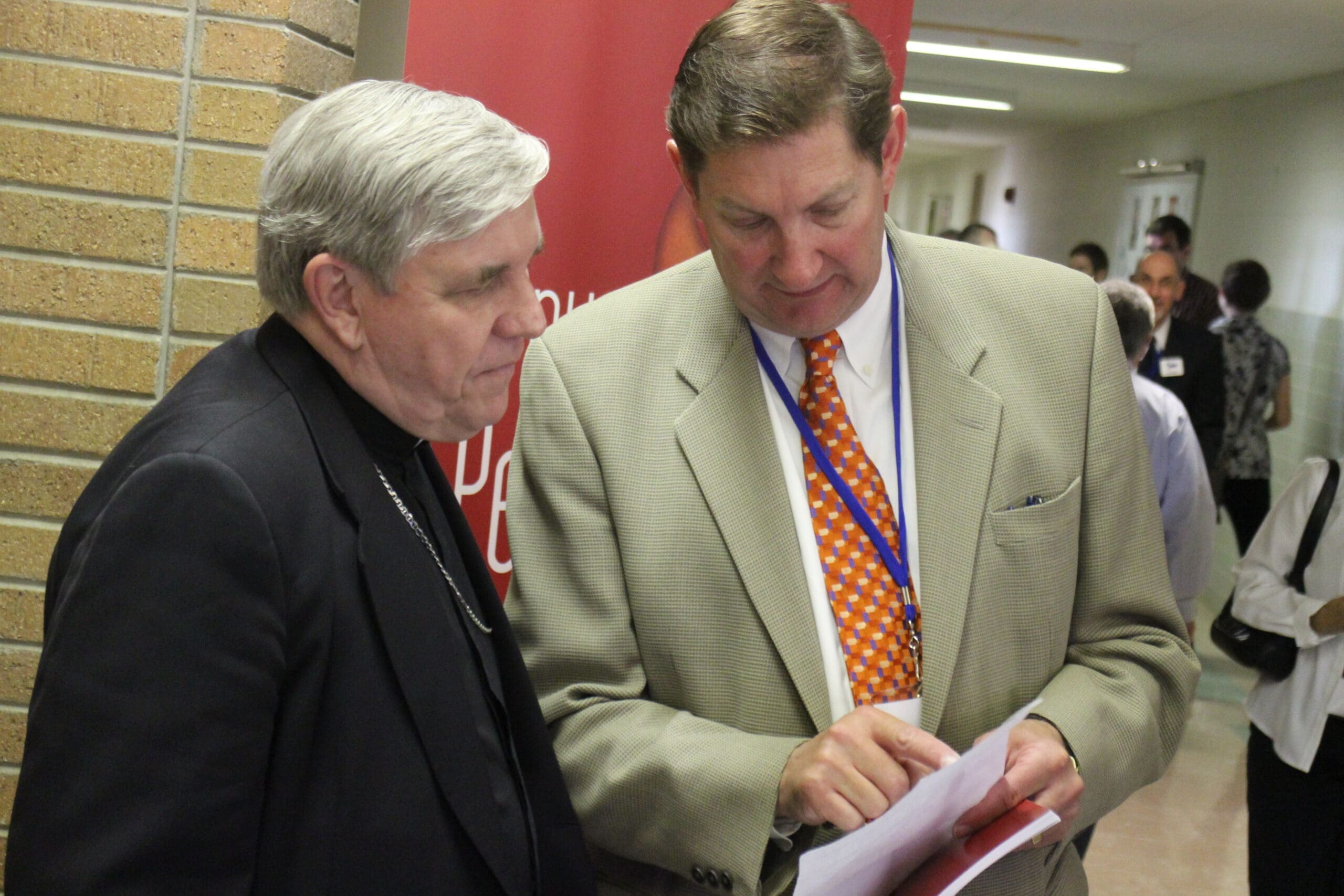
Jerry Topczewski, who worked closely with four archbishops in his decades with the Archdiocese of Milwaukee, consults with Archbishop Jerome E. Listecki in 2016 at the Mary Mother of the Church Pastoral Center in St. Francis. (File photo)
Since coming to work at the central offices of the Archdiocese of Milwaukee in 1997, Jerry Topczewski has had a few different job titles.
First, it was “Archbishop’s Delegate for Communications.” Then, it was “Chief of Staff to the Archbishop.” In the last few months of his career in the Church, it was “Archbishop’s Delegate for Special Projects.”
But whatever the job was called, from Topczewski’s point of view, the mission has always remained the same: empower the men and women serving the archdiocese — from the archbishop himself down to the most recent junior hire — to serve Holy Mother Church with boldness and passion.
“I never really identified myself as the chief of staff. I always just told people I worked in the archbishop’s office. It’s not about me,” said Topczewski. “I would say it’s about the archbishop; that’s who I served. And they would say, ‘No — it’s about Christ.’”
Topczewski retired at the end of December.
Milwaukee’s archbishop of one year, the Most Rev. Jeffrey S. Grob, said Topczewski will be missed.
“Congratulations to Jerry Topczewski on a well-earned retirement after 28 years of service. His institutional knowledge, steady leadership and service under four archbishops made a lasting impact. Jerry’s vast knowledge of the archdiocese was invaluable in helping me get oriented in my early months here,” Archbishop Grob said.
 Topzcewski, who attends St. Dominic, Brookfield, was born and raised Catholic, graduating from St. Matthias Parish School and Pius XI High School, both in Milwaukee.
After receiving a journalism degree from the University of Wisconsin-Milwaukee, he had held a variety of positions when he saw a classified ad in the Sunday paper in 1997 for an opening at the archdiocese.
Even as a lifelong Catholic, Topczewski said he knew little about the inner workings of the Church. His initial interview was at a Denny’s; when he passed that, he was told that his next sit-down would be at “the Chancery.” He assumed, as would most Milwaukeeans of the time who did not hold some sort of theology degree, that this meant the iconic local restaurant chain, not the local Church administrative offices.
“I asked them which one — the one on South 27th Street? The one in Tosa? The one out west?” he recalled with a laugh.
The mix-up did not hurt his chances; after a meeting at Archbishop Rembert Weakland’s house, Topczewski was hired. Only 35 years old at the time, a young husband and father, he never dreamed it would be his “last stop” — nor, probably, that his tenure of service to the Church would span so many significant and challenging historical moments.
Less than five years into the job, the repercussions of clergy sexual abuse reached a fever pitch in the scandals of 2002. As the head of the archbishop’s communications team, Topczewski suddenly found himself in front of cameras and microphones speaking on behalf of the Church in one of her darkest hours. It was a baptism by fire for which he could never have prepared.
“I didn’t have any magic background in media relations,” he said.
But “for good or bad, I did become the face of the local Church, and sometimes the defender of Holy Mother Church. And sometimes you make some mistakes or you misspeak. But somewhere along the way, after a period of time, I don’t remember when, I became very aggressive in defending the Church with reporters. To me, the role was to defend the truth and not let alternate narratives take root and become fact.”
“There is little doubt that Jerry exercised his position of leadership during the most turbulent times in the history of the Archdiocese of Milwaukee,” Archbishop Emeritus Jerome E. Listecki told the Catholic Herald, praising Topczewski’s steady presence throughout the years. “I and my predecessors relied upon his advice in exercising our leadership for the good of the Church … he was a joy to work with because his faith dictated the relationship to his work.”
The work, in return, enriched Topczewski’s faith — in particular, his understanding and appreciation of the Holy Spirit. Among the challenging moments, his career saw plenty of profoundly beautiful ones, like the Jubilee Year 2000, the 2014 Archdiocesan Synod, the incorporation of Seton Catholic Schools and the Catholic Comeback in 2020 following the pandemic.
Those were the times, recalled Topczewski, that taught him how the Holy Spirit works.
“It’s simple things — when you’re looking for the right word or the right phrase — or big things, like the synod. This is the Spirit at work,” he said. “There’s no doubt about it.”
Topczewski has been contemplating retirement for several years but wanted to support Archbishop Grob throughout the first few months of his episcopacy.
The timing now is finally right, and he is looking forward to spending time traveling with his wife, Bonnie, visiting their adult children and two granddaughters, playing golf and staying involved in ministries and organizations important to him.
He may not be in the office every day, he assured Archbishop Grob, but he’s only a phone call away.
“I’ve had other jobs outside the Church, but working for the Church is more personal, and it’s part of your own vocation. It really becomes intertwined with your identity,” he said. “I say this often — it’s a privilege to work for the Church. When you’re a believer, what could be better?”
