
The Rev. Dr. Martin Luther King Jr.’s legacy is one of answering the Christ-centered call to building a more just world when it is challenging.
The Archdiocese of Milwaukee will celebrate that legacy and focus on how we’re called to answer the issues of our time, during “Facing the Challenges of a New Age,” the Rev. Dr. Martin Luther King Jr. 35th Annual Memorial Prayer Service, timed near the federal holiday in his honor, this year on Jan. 19.
Archbishop Jeffrey S. Grob will preside at the prayer service at 1:30 p.m. Saturday, Jan. 17, at All Saints, 4051 N. 25th St., Milwaukee, and the keynote speaker will be Vevette Hill-Nwagbaraocha, assistant director of Marquette University Campus Ministry.
Rev. Dr. Martin Luther King Jr. was a social activist and Baptist minister who was a leader in the American civil rights movement from the mid-1950s until his assassination in 1968. King, regarded as a preeminent advocate of nonviolence, was awarded the Nobel Peace Prize in 1964.
“What makes Dr. King so extraordinarily unique is the time in which he was, his ethnicity and the risks that he was taking when he was taking them. You always want to acknowledge that,” Hill-Nwagbaraocha said in a recent interview. “He wasn’t by himself, but he was pushed to the forefront, and he held a position that was very, very difficult.”
She said that we should examine what Dr. King exhorted all to do in his time, and see all the places where his calling applies today, when many issues of civil rights, justice and the dignity of God’s people still prevail.
“Many people are misled to believe that things are much better than they are. People can point to some of the accomplishments that have been made, particularly with people of color and issues of housing discrimination,” she said.
“Major injustice exists. It is overall to remind ourselves and one another and honor the dignity for which we all have been created.”
The Catholic Church has often spoken up on issues of justice, particularly in the young papacy of Pope Leo XIV, who grew up scant miles from where Dr. King often marched on Chicago’s south side.
The Holy Father’s recent apostolic exhortation, “Dilexi Te,” shared countless examples of actions of social justice on both a local and global scale throughout salvation history.
In each case, those biblical characters, those saints, and of course Jesus himself, each answered the same question that Hill-Nwagbaraocha broaches, one often asked by Dr. King.
“The message of Dr. King in many of the things that he said is, ‘Why not me?’ I feel like every group of people have had to answer that call,” she said.
She adds, however, that taking that initiative is sourced from understanding whom we belong to — Jesus Christ.
“Your ‘yes’ can’t come if you don’t know who you are and whose you are. The enemy of human nature, the enemy of the human spirit says, ‘Protect you. There isn’t enough,’” she says, discussing the wrongs of an attitude of scarcity instead of the belief in the infinite abundance of God.
“‘If they have some, you won’t have any, you won’t have enough.’ And that is all a lie. The God that we serve, the Magis (Latin for more) — there will always be enough.”
Hill-Nwagbaraocha says that grounding ourselves in that belief of abundance begins the process. The next step involves discerning where we are called to serve.
“We’re not all called to do everything. We’re called to something specific. We have a general calling,” she said. “That’s where we start. ‘What can I do? What is in the sphere of my authority?’ God gives us all authority.”
She says that sometimes, that space of authority isn’t in the place of superhero effect, but like both Dr. King and St. Teresa of Kolkata each suggested, to do small things with great love.
“Dr. King said, ‘If you’re a street sweeper, sweep them for God. Somebody is always watching you,’” she said.
“I’m not voting just for me. I’m not speaking just for me. I’m not teaching just for me. I’m not singing just for me. ‘This is for your glory and our good.’”
Hill-Nwagbaraocha also shares how hard the road of facing the challenges of answering “yes” can be, a road Dr. King walked with jailings and threats of violence constantly surrounding him, the kind of violence that eventually took his life in 1968.
It again is the kind of “yes” that so many in salvation history, including the Blessed Mother, gave to God.
“To say, ‘Yes, I’m going to do the right thing’ and not know the cost that you’re going to pay for it, whether you’re talking about our Holy Mother saying ‘Yes, I don’t know what the cost is going to be, God, but I trust you,’ or whether the yes is Dr. King saying it,” she says.
“The yes may be, ‘I’m in the middle of not knowing where my life is going, and I’m working in a situation where some things are not going well, and my yes is going to be to stand up and risk being fired because this is the right thing to do.’”
Hill-Nwagbaraocha says every instance is an opportunity to continue Dr. King’s mission.
“The fire is still burning,” she said. “It’s what we hope for people to take away and to do with the authentic power that was in Dr. King and that is in all of us, and that is the power of our Lord.”
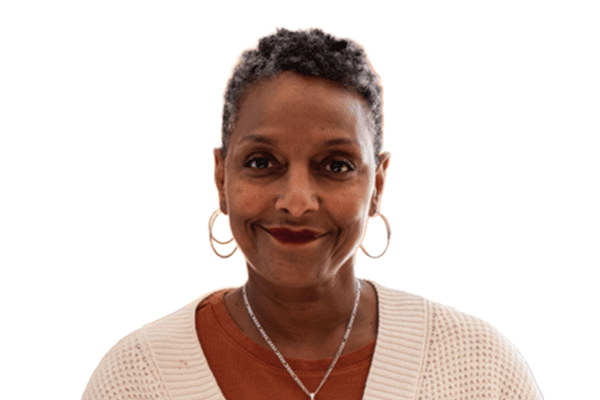
Vevette Hill-Nwagbaraocha. (Submitted photo)
