(Archive Photo)
From innovative academic programs to expanded access and faith formation, Catholic colleges and universities across the Archdiocese of Milwaukee are adapting to meet the needs of today’s students while remaining rooted in their founding missions.

Alverno College, Milwaukee
Founded in 1887 by the School Sisters of St. Francis, Alverno College is a nationally recognized leader in innovative, ability-based education. In 2026, Newsweek ranked Alverno No. 5 in its inaugural list of America’s Best Colleges for Women, and Alverno was ranked third among Midwest Regional Universities for undergraduate teaching in U.S. News & World Report’s 2026 College Rankings.
Over the last several years, Alverno responded to the needs of students by shifting away from low-enrollment programs and increasing online and hybrid delivery models at the undergraduate and graduate levels, said Mariana Sanabria, Vice President of Enrollment Services. Starting in fall of 2027, Alverno will offer its psychology and social work undergraduate majors as fully online majors. The college also recently partnered with Milwaukee Public Schools to offer direct admit to MPS juniors in spring 2026 for admission in fall 2027.
With a heavy emphasis on disciplines in nursing, mental health, education, science and business, Alverno continues to shift programs to ensure successful career outcomes, landing the college at seventh place in the state of Wisconsin for median earnings of its graduates.
Alverno President Christy Brown, JD, described the school as “a Catholic college rooted in the Franciscan tradition.”
“We embrace the Gospel call to honor the dignity of each person and promote each one’s integral development as a human person,” she said.

Marian University, Fond du Lac
Founded as Marian College in 1936 by the Congregation of Sisters of St. Agnes, Marian University has expanded from its origins as a teacher-training college into a comprehensive Catholic university whose undergraduate and graduate offerings include 40 majors, along with adult accelerated online undergraduate and graduate options.
In recent years, the university has focused on strategic enrollment growth and retention initiatives that have successfully attracted over 1,300 students across both undergraduate and graduate programs, with more than 930 undergraduate students enrolled in the fall of 2025.
Recent initiatives include lowered tuition on allied health completion programs, allowing students in the nursing, radiologic technology, dental hygiene, diagnostic medical sonography and respiratory therapy completion programs a more affordable degree. Marian also offers an online social work program as well as a social work bridge program for students who hold a bachelor’s degree in another field.

Marquette University, Milwaukee
Named for the famous French missionary and explorer Rev. Jacques Marquette, SJ, Marquette University was founded in 1881 and is run by the Society of Jesus, commonly referred to as the Jesuits, an order founded in 1540 by St. Ignatius of Loyola.
“Marquette University is proud to be part of an over 500-year tradition of education,” said Steve Blaha, Director of Campus Ministry. “At Marquette, students are invited to live and think deeply, to expand their horizons, and to develop a strong compass. A Catholic, Jesuit education encourages students to become well-versed in what it means to be human and to understand the human experience.”
Just over 8,000 undergraduate students were enrolled at Marquette for the 2025-26 school year, 22-percent of whom are first-generation college students. The school has a 14-to-1 faculty ratio, more than 100 study abroad programs, and over 300 clubs and organizations for students to choose from. The campus has 17 worship spaces, including the 15th century St. Joan of Arc Chapel and the historic Church of the Gesu.
Marquette was ranked first in the country for the community service engagement of its students by The Princeton Review.
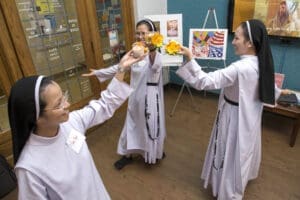
Mount Mary University, Milwaukee
The first four-year Catholic college for women in Wisconsin, Mount Mary University has a long history of providing access to college and post-graduate degrees for underserved populations.
That history is still very much alive in its current mission, said President Isabelle Cherney, Ph.D. Mount Mary was ranked second in the Midwest for social mobility by the U.S. News & World Report’s 2025 College Rankings, an indication of how effectively an institution graduates students who receive federal Pell Grants.
“One hundred percent of our undergraduate students receive aid of some sort, and we’re actually cheaper than most state schools,” she added.
Mount Mary offers over 50 undergraduate majors, programs and certifications, and 12 graduate programs with a 9-to-1 student-to-faculty ratio. The school also recently began offering reduced credit programs, enabling students in specific majors to complete their degree in three years. Currently, three majors (social work, cybersecurity and digital marketing) are included in the reduced credit program, with several other majors in the process of being accredited by the Higher Learning Commission.
“We see it as an access issue,” said Dr. Kristen Carioti, Ph.D., Dean of the School of Arts and Sciences. “For a lot of students, this is a whole quarter of their tuition knocked off, and they’re getting into their jobs and careers sooner.”

Sacred Heart Seminary and School of Theology, Hales Corners
Since 1932, the Priests of the Sacred Heart (known as “Dehonians” after their founder, Venerable Leo John Dehon) have sponsored a seminary program at their Hales Corners monastery, which also serves as the order’s United States headquarters. Initially, the program offered formation for Dehonian seminarians, but the seminary today, which has come to be known as Sacred Heart Seminary and School of Theology, provides priestly formation to resident seminarians from orders and dioceses around the country. Seminarians who receive human, spiritual and/or pastoral formation from Saint Francis de Sales Seminary also come to SHSST to receive their academic formation. The school of theology also serves clergy and lay people through its Master of Arts and English & Culture Studies programs.
More than 130 seminarians study at the seminary, with about 81 percent enrolled full-time. These seminarians represent a variety of cultural backgrounds, and student retention rates stand at 88 percent for both priestly formation and MA programs.
“Education is ever-changing, with the intention of passing on timeless values,” said the school’s president-rector, Very Rev. Stephen Huffstetter, SCJ. “We draw on ancient traditions, while being attentive to new developments in learning and technology, to prepare ministers who can meet future challenges.”
Graduate degrees offered at SHSST include a Master of Arts in Theology that can be achieved through two pathways — the Lumen Cordis daytime program with concentrations in Scripture or systematic theology, or the innovative Cor Unum evening cohort-based program designed especially for lay leaders and working adults.
SHSST reports that 100 percent of MA graduates in 2024 and 2025 were employed in a field related to their degree.