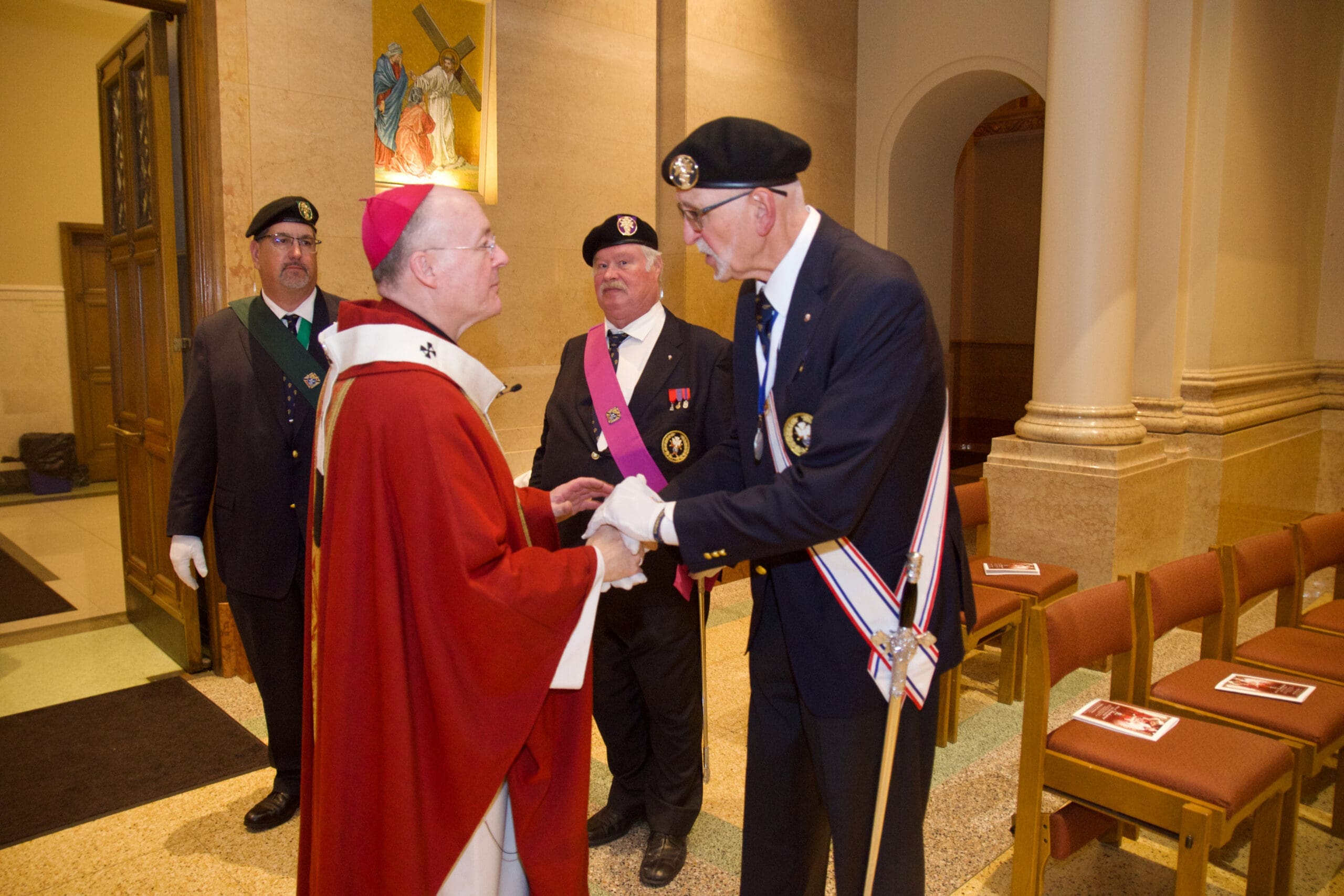
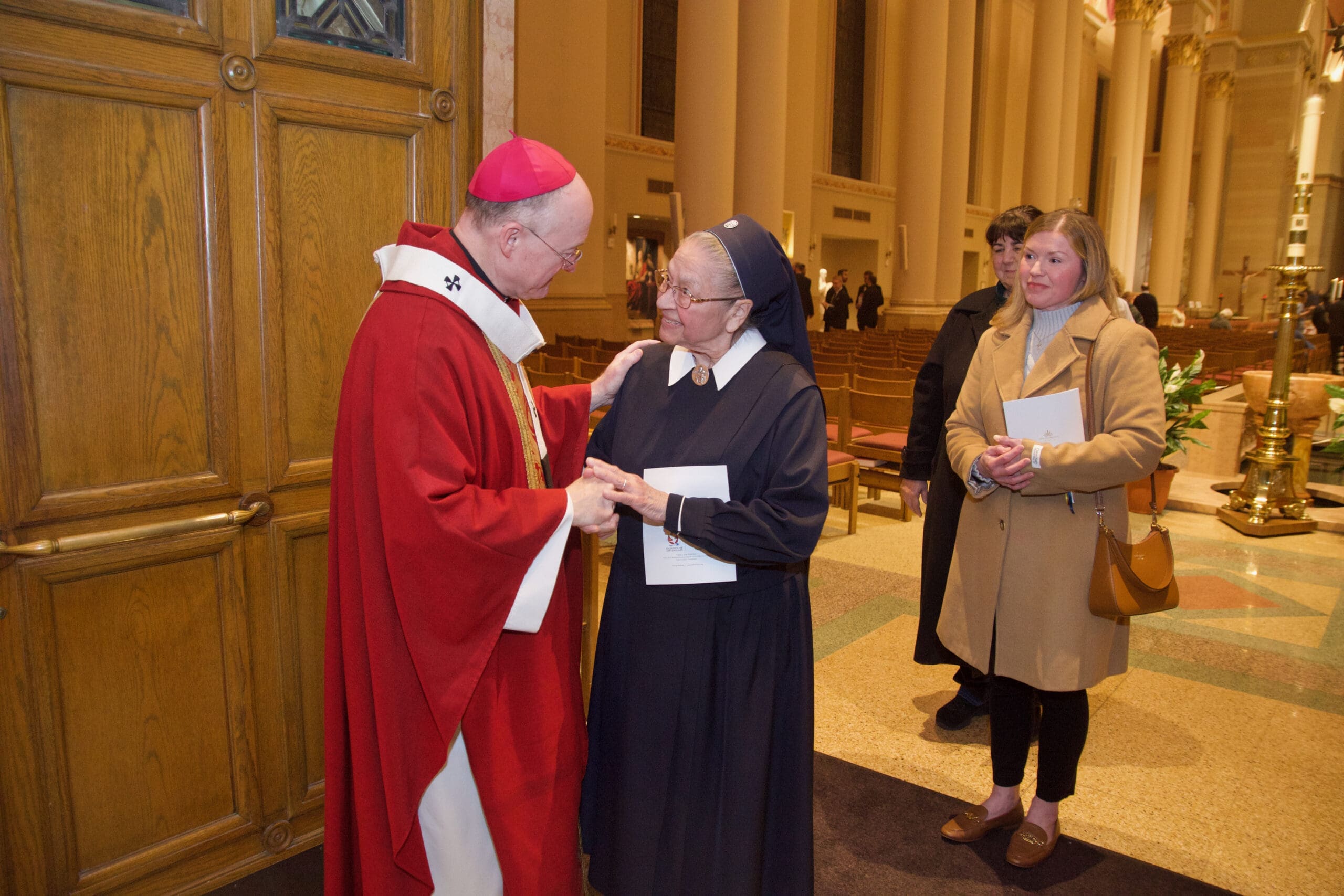
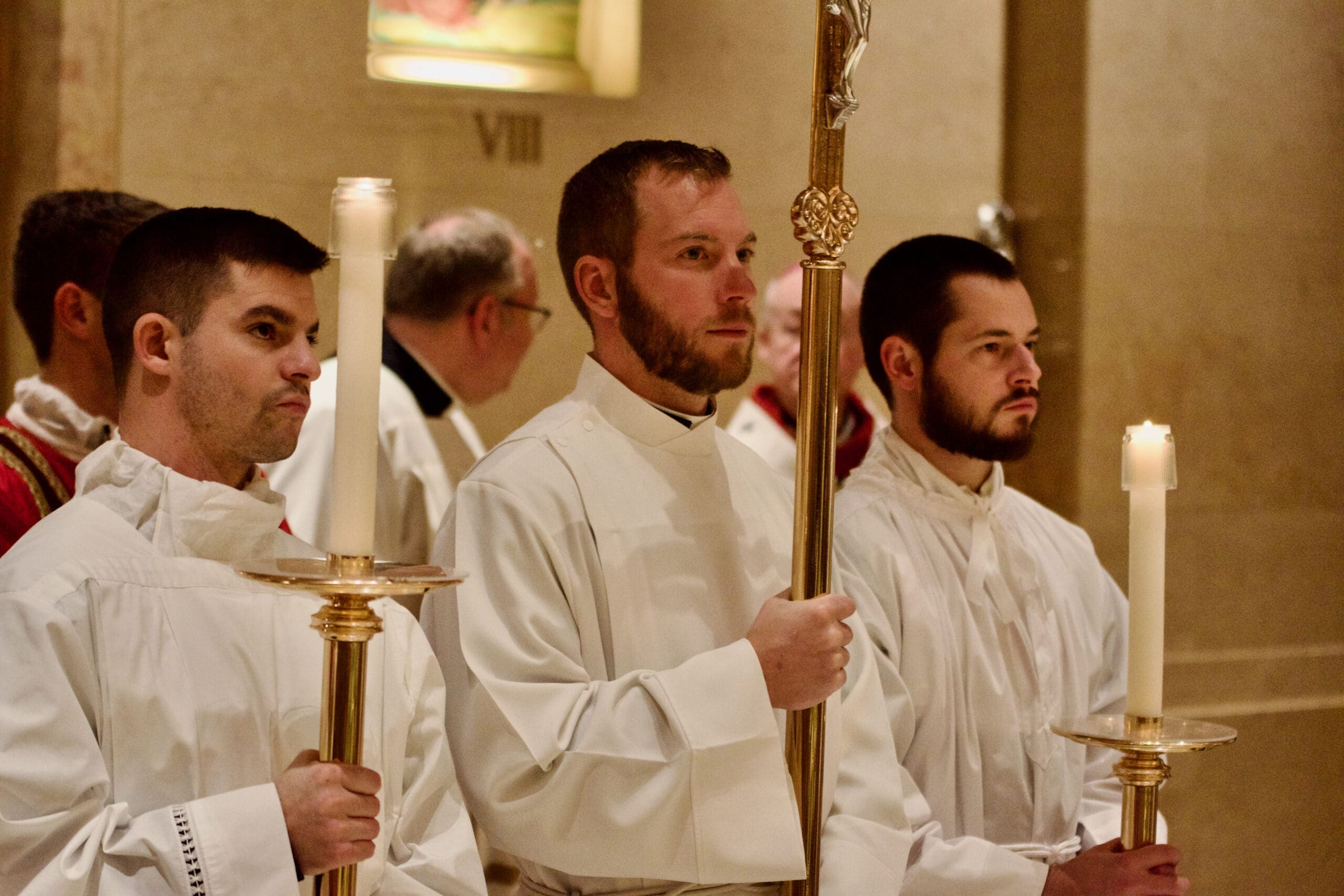
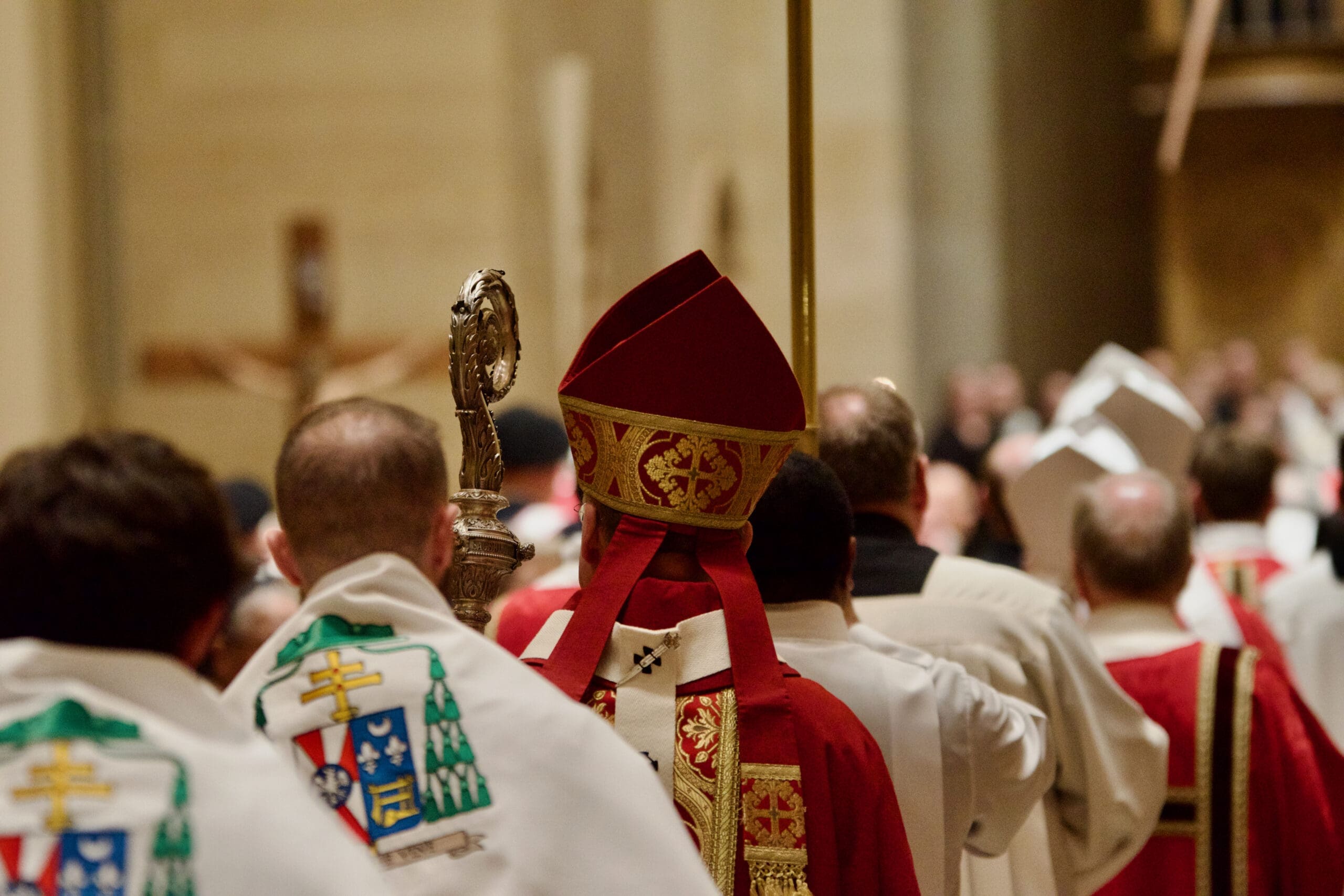
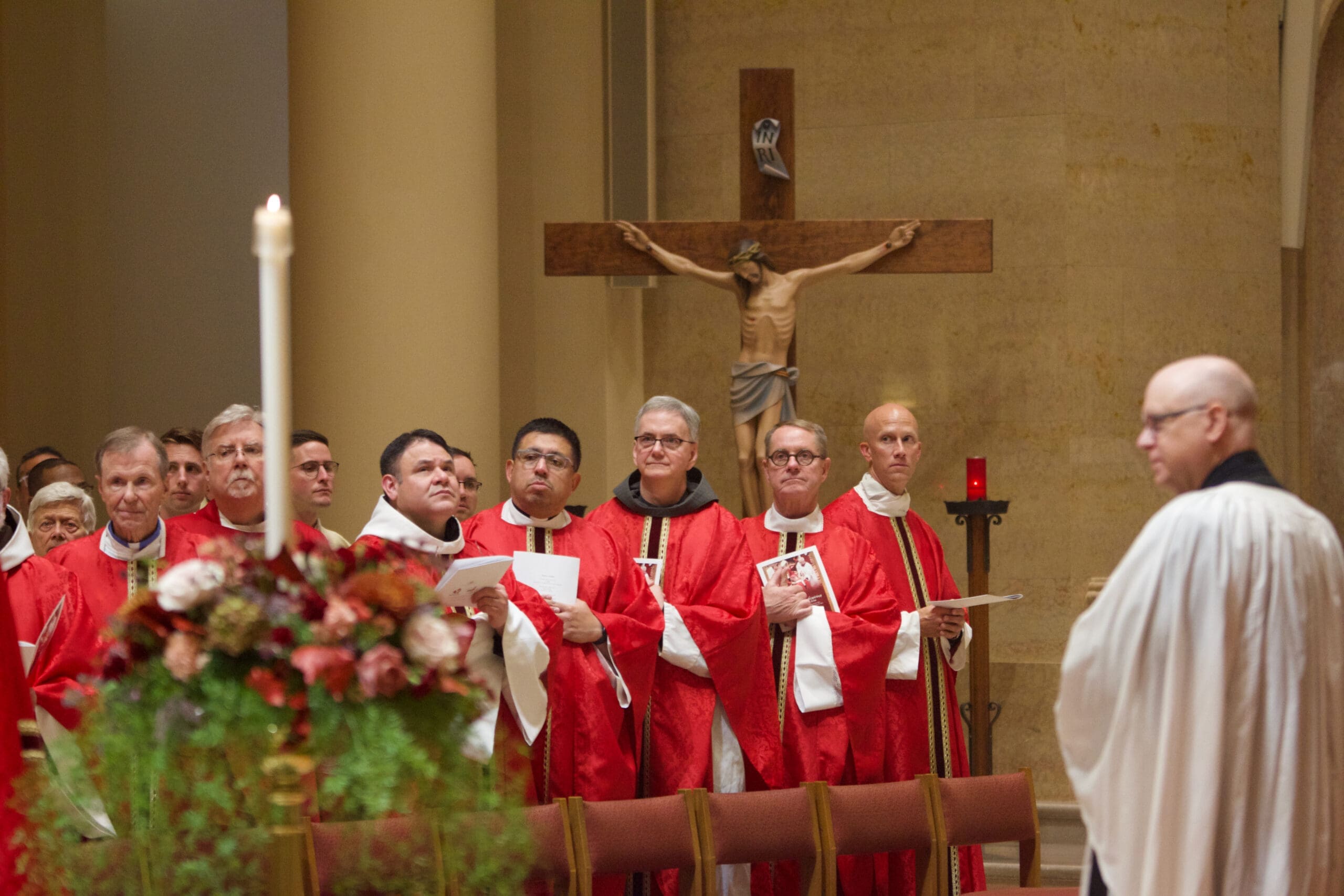
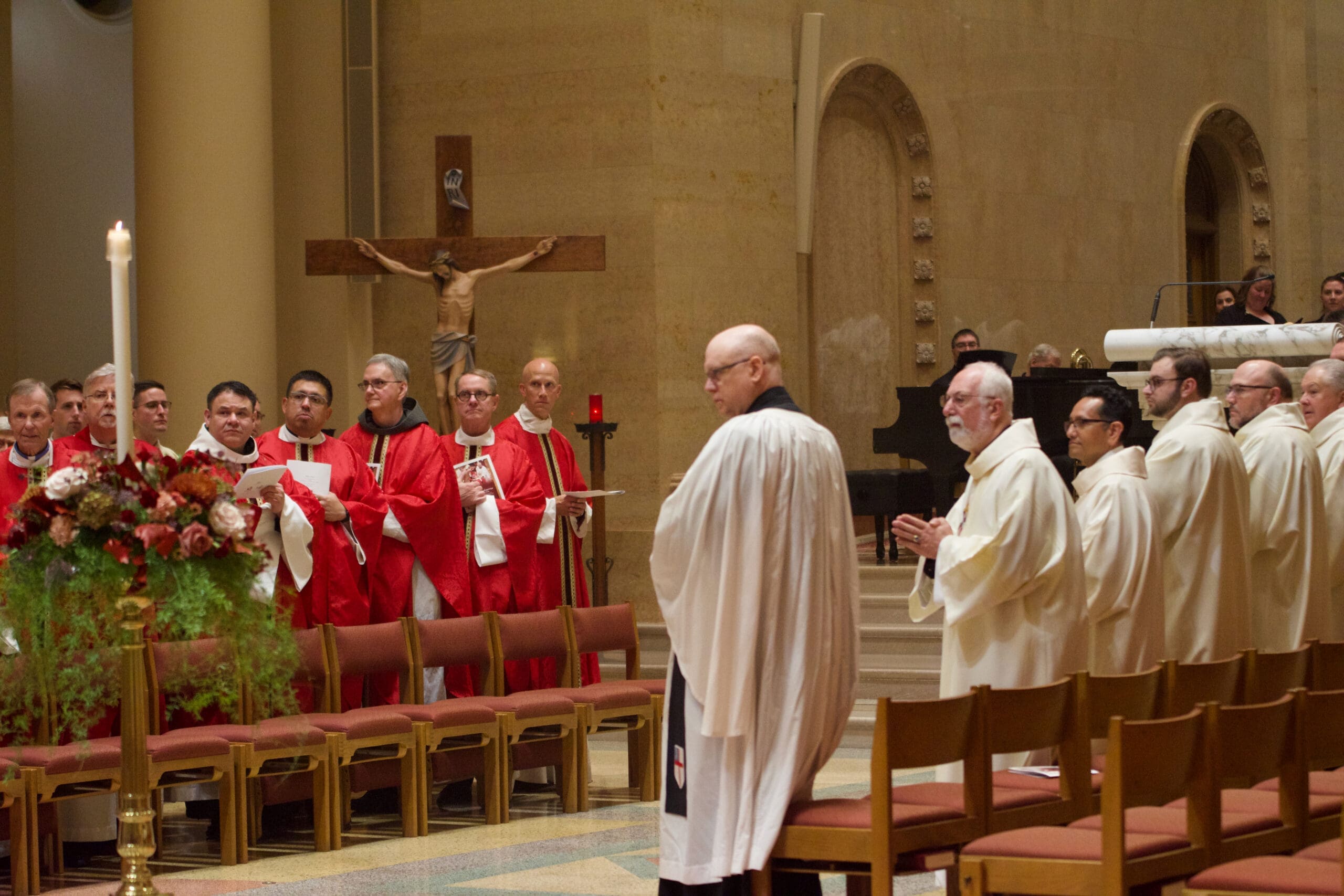
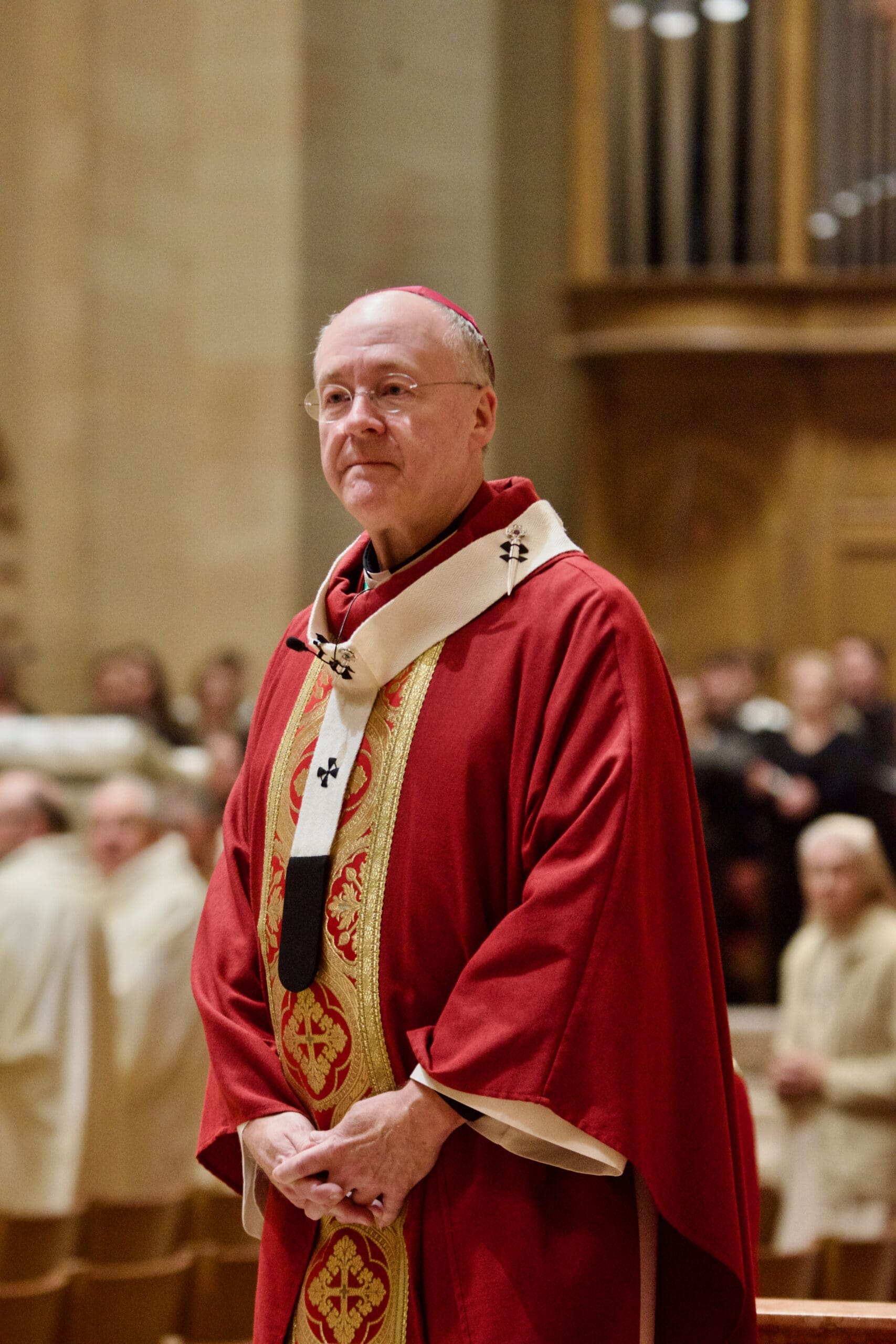
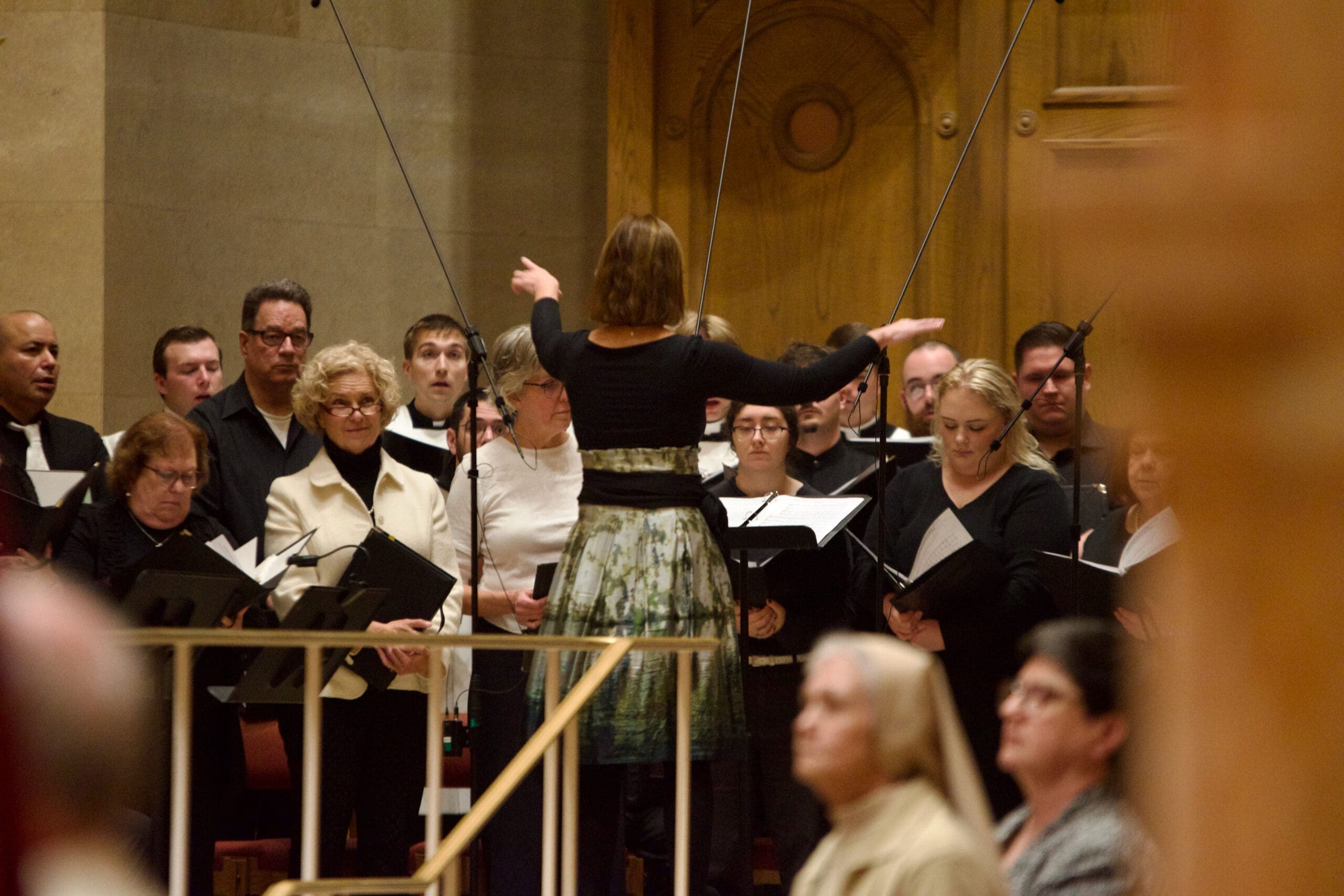
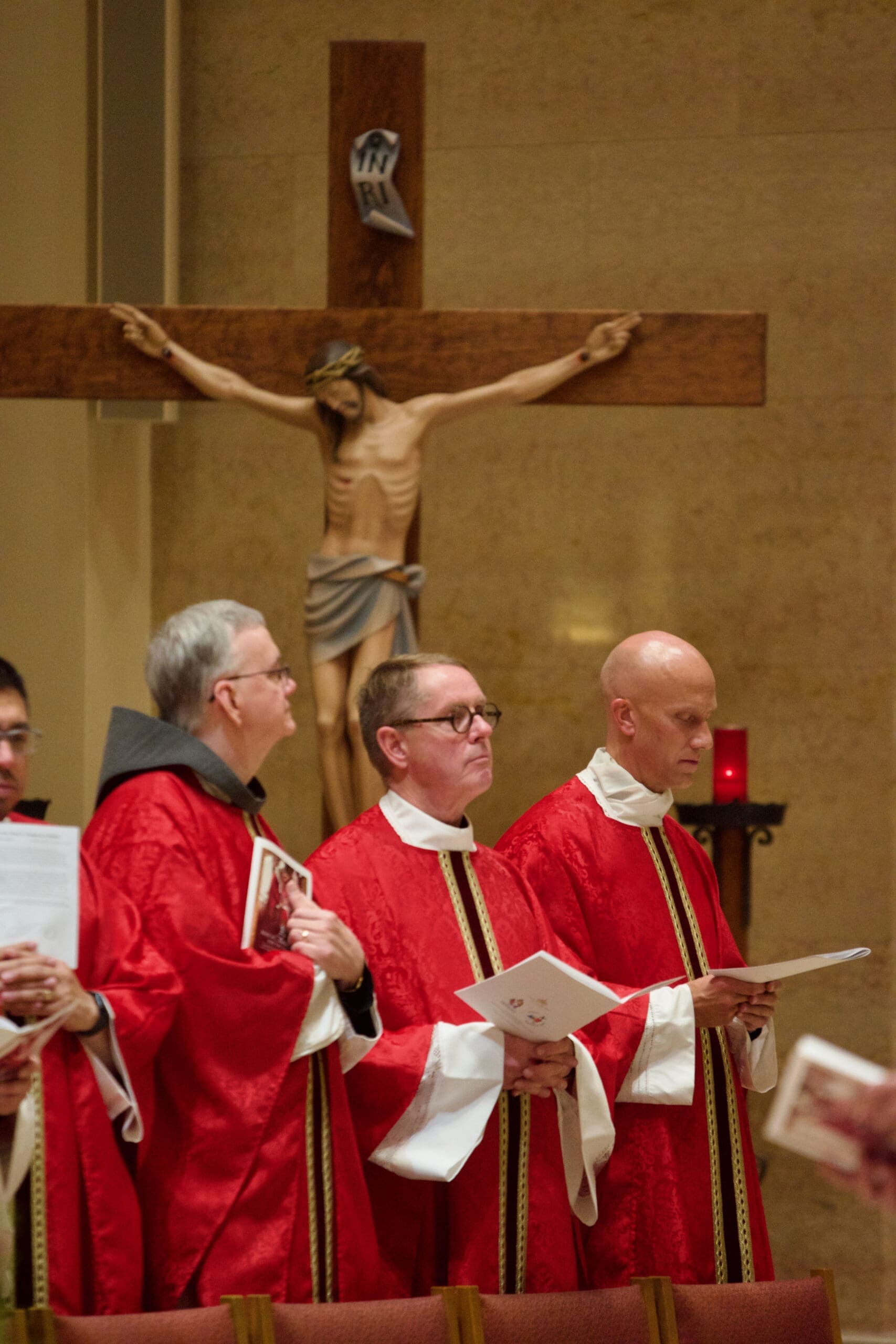
Archbishop Jeffrey S. Grob carries a crozier used by the Most Rev. Frederick Xavier Katzer, archbishop of Milwaukee from 1891 to 1903, at a Mass of Thanksgiving on Nov. 3 at the Cathedral of St. John the Evangelist, Milwaukee. (Photo by Sean Smith)
Far from being a fashion statement, the pallium is instead more aptly described as a relationship statement.
This white stole-like garment worn by a metropolitan archbishop over his vestments is a visible sign of unity between the local Church and the Holy See.
When Archbishop Jeffrey S. Grob received his pallium from Pope Leo XIV last summer in Rome, the Holy Father described the garment to the archbishops in attendance as a “sign of pastoral responsibility entrusted to you … so that in the unity of the Catholic faith, each of you may build up that communion in your local churches.”
In his greeting to the congregation Nov. 3 at a Mass of Thanksgiving for the pallium at the Cathedral of St. John the Evangelist, Milwaukee, Archbishop Grob echoed Pope Leo’s sentiments.
“That’s why we’re here, gathered together, connected,” he said. “(It is) not about a person but about a relationship.”
The Gospel for the evening’s Mass was taken from Matthew 16:13-19, in which Jesus establishes apostolic succession, telling Peter: “I will give you the keys to the kingdom of heaven. Whatever you bind on earth shall be bound in heaven; and whatever you loose on earth shall be loosed in heaven.”
The image of keys is a powerful one, the archbishop said in his homily.
Keys are given at significant moments in life, ones that usually correspond to a milestone of maturity or responsibility in the recipient.
“You may recall your own experiences of relationships with keys — receiving the keys to your first home, giving the car keys to a teenager for the first time, entrusting someone with the key to your heart, poetically speaking,” he said.
But with that maturity and responsibility also comes “the demand for continued growth,” he added, observing that what is so significant about Jesus’ choice to entrust Peter with this sacred office is the recollection of Christ’s own frequent criticism of human leaders like the scribes and Pharisees.
“Jesus’ gesture of offering the keys to Peter is less about what kind of rock he is and more about the Lord’s regard for Peter’s potential,” he noted. “And, might I say, for human potential in general. It is less about Peter’s faith in Christ and more about Christ’s faith in him.”
Though Christ is often critical of institutions or even of individuals, he “doesn’t write them off,” the archbishop reminded the congregation.
“A lesson for all of us to continue to grapple with, especially in a world where we want to write certain people off,” he said. “Our Lord continues to trust in their potential.”
The Catholic tradition is “founded on such moments of challenge and promise as we see encountered in this evening’s Gospel,” he continued.
“It is not so much Peter’s checkered history, or for that matter, the checkered history of the Church, or of the papacy over the ages, that is at issue here,” he said. “It’s instead God’s fidelity to human beings, and God’s insistence that human beings can be trusted to carry out God’s will.”
Despite the perpetual shortcomings of humanity, God entrusts to human beings (St. Peter and his heirs) and to human institutions (the Church) an opportunity and a responsibility to bring souls to Heaven, the archbishop said — “to invite people into a place where healing and reconciliation can be found, where love and mercy can be celebrated, where a festive table is set.”
All the baptized have been given keys to the Kingdom of Heaven, the archbishop continued. “All of us. Everyone in this space, all who pledge belief in God, all of us possess the potential to open certain doors and to close others,” he said. “To bind up wounds, to loose from fear and guilt. To invite others to share the feast that we have already begun to taste.
“And as I stand before you this evening, it is the desire of my heart to continue doing such things as these, and many more, alongside of you, as archbishop.”