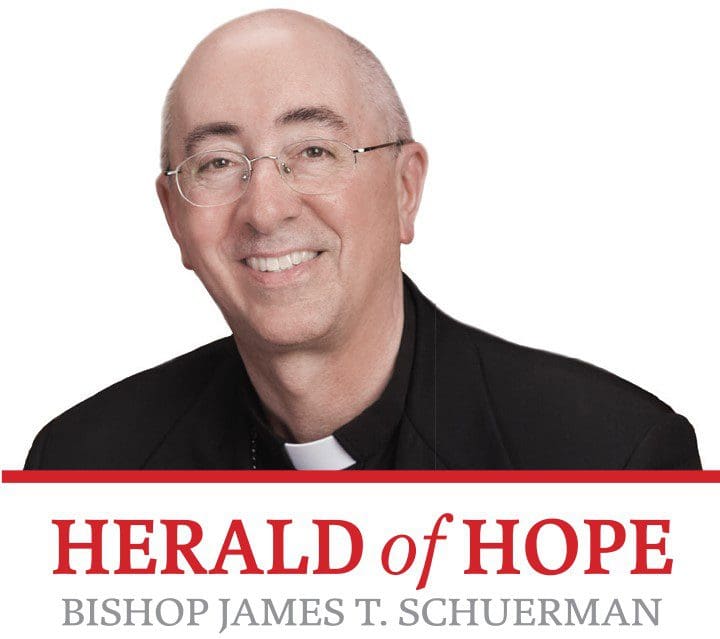
Herald of Hope
The Gospel according to St. Luke tells us that Jesus began his ministry teaching in the synagogues throughout Galilee. When he came to Nazareth, his hometown, he entered the synagogue and read a passage from the Book of the Prophet Isaiah: “The Spirit of the Lord is upon me, because he has anointed me to bring glad tidings to the poor. He has sent me to proclaim liberty to captives and recovery of sight to the blind, to let the oppressed go free, and to proclaim a year acceptable to the Lord.”
After reading this, Jesus sat down and said to those present, “Today this scripture passage is fulfilled in your hearing.” In other words, Jesus identified himself as the fulfillment of the prophecy about the one sent by God and anointed with the Spirit to bring salvation. (See Luke 4:16-21)
The Gospel according to Luke has a special concern for those in need. Salvation, in St. Luke’s Gospel, has very concrete dimensions. The poor, the imprisoned and the sick are promised release from the things that oppress them. Throughout the Gospel of Luke, the focus on the poor of this world is frequent.
A good illustration of this is St. Luke’s version of the Beatitudes. We are probably more familiar with St. Matthew’s version, which is a part of the Sermon on the Mount. In St. Matthew’s account, Jesus blesses those who are living according to the values of the Kingdom of Heaven. “Blessed are the poor in spirit, for theirs is the kingdom of heaven.” (Matthew 5:3) In St. Matthew’s version, poverty of spirit is an attitude of putting God first before all things. It implies living with a spirit of detachment from the things of this world.
St. Luke’s version, which is part of the Sermon on the Plain, is more concrete. He does not say, “Blessed are the poor in spirit,” but rather, “Blessed are you who are poor.” (Luke 6:20) Among the members of the community of believers for whom St. Luke was writing were the poor, the downtrodden and the lowly. Throughout his Gospel, St. Luke emphasizes Jesus’ special love and concern for the poor.
St. Luke keenly recognized a great virtue among the poor in his faith community. He observed that the poor recognized that all they had was from God, and so they were generous with the little that they had. If they looked out for the needs of others, they trusted that God would provide for them. Think of the story of the poor widow whom Jesus and his disciples observed in the Temple treasury. While others gave from their surplus, she gave a small coin, sacrificing all that she had, putting her trust in the providence of God. (See Luke 21:1-4)
It is clear in St. Luke’s Gospel that the preaching of the Kingdom of God is good news for those who are poor and oppressed, and that it is divine judgment against those who refuse to be generous with their wealth and prosperity. Jesus says, “Woe to you who are rich.” (Luke 6:24) Here, Jesus is not concerned about how much money a rich person has. Rather, he is concerned with the false sense of security that some people have, putting their trust in their wealth and possessions rather than in God. Remember the parable of the wealthy man who had a great harvest and did not have enough space to store his grain. He decided he would tear down his old barns and bins and build new ones to hold the abundant grain. Then he would say to himself, “… rest, eat, drink, be merry.” But God said to him, “You fool, this night your life will be demanded of you. And the things you have prepared, to whom will they belong?” (See Luke 12:16-21)
What the Gospel teaches is that those who exchange their faith in God for faith in wealth and possessions will have no true joy, and no real future. If we store up only material wealth in this life, we will neglect storing up our treasure in heaven.
The mystery of our faith is this: Jesus came into this world to unite us to God for all eternity. We put our faith not in material things, but in Jesus Christ who suffered, died and rose again to give us new life, and in his promise of the resurrection.
The “Message of the Holy Father for the 9th World Day of the Poor” (which will take place on the 33rd Sunday of Ordinary Time) was released June 13. In this message, the Holy Father frames the Church’s support for the poor in terms of the theological virtues: “Hope is born of faith, which nourishes and sustains it on the foundation of charity, the mother of all virtues. All of us need charity, here and now. Charity is not just a promise; it is a present reality to be embraced with joy and responsibility. Charity engages us and guides our decisions towards the common good. Conversely, those who lack charity not only lack faith and hope; they also rob their neighbors of hope.”
In his message, the Holy Father admonishes individuals, communities and governments not to abandon the poor: “It is my hope, then, that this Jubilee Year will encourage the development of policies aimed at combatting forms of poverty both old and new, as well as implementing new initiatives to support and assist the poorest of the poor.”
We, who are saved through the merciful love of Christ, have a mission in this world. We are to provide our brothers and sisters the experience of the presence of God’s love in this world — the presence of Jesus Christ. Through our acts of kindness, mercy, charity, generosity and hospitality toward those in need, the poor of this world, we show others the love of God.