
The list of adverbs commonly used in reference to the act of dying is a short one. It is sometimes said that a person has died “unexpectedly.” Hopefully, they die “peacefully.”
But dying “well”? Is that even possible?
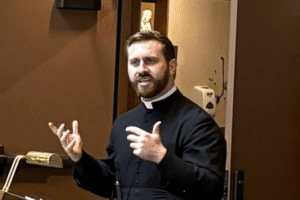
Fr. John LoCoco reflected on the topic in his Jan. 31 talk “Dying Well: The Catholic Art of Spiritual and Sacramental Care,” at St. Mary’s Visitation, Elm Grove.
And for Catholics, said Fr. LoCoco, dying well is not only possible — it is essential.
“Our life leads us to this moment,” he said of death, which he described as “the crucial moment to offer oneself to God, the culminating moment that will submit our whole trajectory toward or away from the Lord.”
Fr. LoCoco’s talk was part of an ongoing speaker series sponsored by the Milwaukee Guild of the Catholic Medical Association. The series is open to the public and seeks “to inform people about medical issues, challenges and solutions from a specifically Catholic perspective in this rapidly changing world,” explained Dr. Franklin Smith, President of the association’s board of directors.
“Fr. LoCoco and I were hoping to present a Catholic perspective on the issue of dying,” he said of the Jan. 31 talk. “Even in Catholic venues such as parishes, talks about the end of life seem mainly to focus on medical decision making, hospice and advance directives — no doubt critically important. But isn’t preparation of the immortal soul just as or even more important? What can we do to help our loved ones or ourselves?”
Ordained in 2018, Fr. LoCoco is the pastor of St. John Vianney, Brookfield, and the Judicial Vicar for the Archdiocese of Milwaukee. Attendees packed the church atrium for his talk, which drew inspiration from the book “Ars Moriendi: A New Annotated Translation.”
Published in 2021 by the National Catholic Bioethics Center, the book is a translation by Fr. Columba Thomas, O.P., M.D., of a medieval text “aimed at equipping the faithful for death and dying,” during a time when illness was rampant, Fr. LoCoco said. The title translates from the Latin to “the art of dying.”
“This is something that we need to be attentive to,” he emphasized, addressing not only the Catholic healthcare professionals present but the lay faithful as well. “I don’t say that as an ominous warning … (but as) the reality: The veil between heaven and earth and hell is much thinner than we might realize.”
Fr. LoCoco spoke of unique temptations designed to exploit the vulnerability of the dying — temptations to lack of faith, to despair, to impatience, to spiritual pride and to avarice.
Every Catholic should be prepared for this reality, for themselves and for their loved ones, and should understand that support of the dying is not something limited to doctors and priests — all faithful Catholics should “see ourselves as participants in the work,” said Fr. LoCoco.
An acute crisis of faith is one specific temptation experienced by those who know death is imminent, according to “Ars Moriendi,” explained Fr. LoCoco — and it’s something he has experienced personally in ministry.
“As we lay there on our deathbeds and the inevitability becomes known to us of our own death, we begin to ask ourselves, ‘Is any of this really true? I don’t know what I believe anymore,’” Fr. LoCoco said. “This is the real spiritual emergency.”
Caregivers and loved ones should resist the urge to dismiss or ignore these doubts and instead aid the dying person in his or her struggle with steadfast prayer, the reading of Scripture and the presence of sacramentals like holy water, a crucifix and the rosary.
But more important than any other action, he counseled, is sending for a priest to administer the three sacraments most needed in this final hour: Penance, Anointing of the Sick and Viaticum, often referred to collectively as “last rites.”
“The Catechism tells us that just as the sacraments of Baptism, Confirmation and the Eucharist form a unity called the Sacraments of Initiation, so too it could be said that Penance, the Anointing of the Sick and the Eucharist — this Viaticum — constitute the end of Christian life, the sacraments that prepare for our heavenly homeland,” he said.
Fr. LoCoco said that it is critical to arrange for these sacraments while the dying person is still lucid and can make a good confession and receive the Eucharist and hopefully the Apostolic Pardon: “Anointing and Viaticum are sacraments for the living, and so the recipient needs to be in a state of grace.”
Sadly, he noted, priests are often not called to the bedside of the dying until the patient is too heavily sedated to confess their sins or to swallow the Eucharist. This is a tragedy, he said, because “this is something that we need to do to prepare the person for eternal life.”
His prayer for his own death, Fr. LoCoco said, has therefore become very specific: that pain management will not render him so sedated that he cannot participate fully in confession, anointing, Viaticum and hopefully the Apostolic Pardon.
“Our practice of the ars moriendi, the art of dying well, means seeing beyond what’s medical to what’s spiritual,” he said. “This is the medieval wisdom that we have lost and we must reclaim — not a denial of death and not certainly an obsession with death, but a preparation for death, the art of dying well, practiced throughout life.”
Fr. LoCoco’s talk in its entirety will be made available on mgcma.org in the coming weeks. The next installment of the MGCMA speaker series will be March 21.
