Colorful Gospel for Dec. 9, 2010
Illustration by Phil YounkClick on the photo for a printable PDF!Based on the Gospel of Matthew 11:2-11Icicle lights. Rope lights. [...]

Illustration by Phil YounkClick on the photo for a printable PDF!Based on the Gospel of Matthew 11:2-11Icicle lights. Rope lights. [...]
It’s not the way I wanted to end the first week of Advent. When I went to bed Thursday night, [...]
"Good News in Bad Times: Discovering Spiritual Meaning in the Midst of Crisis and Uncertainty" by John P. Lozano. Kairos Missions/Acta Publications (Chicago, 2010). 208 pp., $14.95.
"Walking Together: Discovering the Catholic Tradition of Spiritual Friendship" by Mary DeTurris Poust. Ave Maria Press (Notre Dame, Ind., 2010). 192 pp., $13.95.
"Safely Through the Storm: 120 Reflections on Hope" by Debra Herbeck. Servant Books (Cincinnati, 2010). 81 pp., $12.99.
"Good News in Bad Times" by John Lozano, "Walking Together" by Mary DeTurris Poust and "Safely Through the Storm" by Debra Herbeck offer hope to those struggling to find spiritual meaning in the midst of suffering.
PROVIDENCE, R.I. –– Although the 18 seminarians studying at the American College of the Immaculate Conception in Leuven, Belgium, were [...]
Illustration by Phil YounkClick on the photo for a printable PDF! Based on the Gospel of Matthew 3:1-12He lived in [...]
Illustration by Phil YounkClick on the photo for a printable PDF!Based on the Gospel of Matthew 24:37-44Looking backward and forward. [...]
Many people have been asking Matt and I the same question since we got married, mainly how marriage life is [...]
WASHINGTON –– Here are some new books suitable for Christmas giving or with Christmas themes: – "Revelation of the Magi: [...]
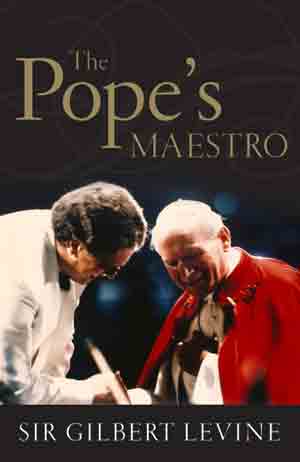
"The Pope's Maestro" by Sir Gilbert Levine. Jossey-Bass (San Francisco, 2010). 466 pp., $27.95.
"The Pope's Maestro" is the memoir of the distinguished conductor, Sir Gilbert Levine, that focuses on his friendship and artistic partnership with Pope John Paul II. For his services to the Vatican, the pope named Levine a Knight Commander of the Pontifical Equestrian Order of St. Gregory the Great, an immense honor to anyone but especially to a Jewish American. From the start, the relationship between these two men would go in unexpected and spiritually rich directions.
A series of guest-conducting assignments brought Levine to Krakow, Poland, in 1987 to lead a concert with the Krakow Philharmonic. To his astonishment, after the first, successful concert with the Philharmonic, Levine was asked if he would become the musical director of the orchestra.
He would become the only Westerner conducting in the Eastern bloc, in a country where Jews had been murdered by the millions 40 years earlier, but, after some time to reflect upon this opportunity, Levine accepted the job. He quickly learned that phone tapping and surveillance was a part of life in the final years of communist rule. But, despite the difficulties, Levine found a new depth and purpose in his life as a Jew in a place where the vestiges of Jewish life had been almost completely destroyed.

 Early this year, St. Nicholas Hospital in Sheboygan let us know about HALO, Hope After Loss Organization, a program offered through the hospital to assist parents who have suffered a pregnancy loss. It was one of those stories we were eager to share with our readers as it highlighted an effort that helped young families through a very difficult time in their lives.
Yet, it was also one of those stories that is a bit evergreen in the sense that it wasn’t tied to a specific date or event. Therefore, we could run it when we had the space and the time to complete it.
With a small staff, other stories took priority, and months went by before we scheduled it for the paper. I share all this background because this issue of Catholic Herald Parenting features that story, and in a sense, it’s a better story than had we run it when we first learned about the program. I say that because the story now has an even happier ending!