Colorful Gospel for Jan. 13, 2011
Illustration by Phil YounkClick on the photo for a printable PDF!Based on the Gospel of John 1:29-34Testimony and witness. John [...]

Illustration by Phil YounkClick on the photo for a printable PDF!Based on the Gospel of John 1:29-34Testimony and witness. John [...]
Illustration by Phil YounkClick on the photo for a printable PDF!Based on the Gospel of Matthew 3:13-17Fast forward in time! [...]
The end of the year brings with it the end of the "Grandma's car" saga that began Dec. 3. The [...]
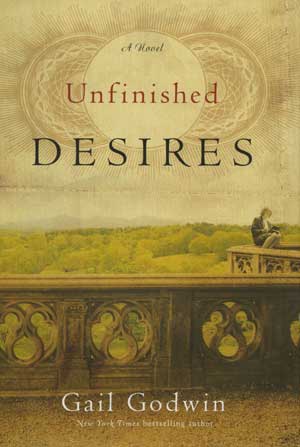
"Unfinished Desires" by Gail Godwin. Random House (New York, 2009). 393 pp., $26.
Gail Godwin's novel "Unfinished Desires" chronicles a notoriously mischievous freshman class at a fictional all-girls Catholic school in Mountain City, N.C. As the girls run out teachers and compromise the integrity of the school, the principal desperately tries to maintain the school's reputation and her authority by controlling the class ringleader.
Family history and deep-seated blame for a death further complicate the power struggle and mind games between Mother Suzanne Ravenel, the principal, and Tildy Stratton, the class troublemaker.
Before taking her vows, Mother Ravenel was a student at the school with Tildy's mother and twin sister, who died in a tragic accident abroad. The family forever blamed Mother Ravenel for indirectly causing the death. To a fault, this family story is retold ad nauseum from several characters' perspectives throughout the book.
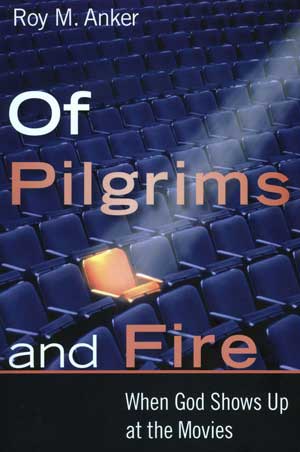
"Of Pilgrims and Fire: When God Shows Up at the Movies" by Roy M. Anker. Wm. B. Eerdmans (Grand Rapids, Mich., 2010). 249 pp., $17.99.
What good are movies when it comes to faith, spirituality and religion? Roy M. Anker, the author of "Of Pilgrims and Fire," who teaches literature and film at Calvin College in Grand Rapids, Mich., brings both a classic Protestant suspicion of the world and a Catholic sacramental imagination – often in tension with each other – to this enlightening book.
Anker's preference for "pilgrimage" as a basic metaphor for a Christian perspective on life and the world reveals the Protestant lenses through which he looks at movies. Indeed, in this book the metaphor of "pilgrimage" often seems to echo classics such as John Bunyan's "The Pilgrim's Progress" (17th century). The first metaphor Anker suggests for the world is "darkness." He writes that, "For all our techno-dazzle in getting around quickly via cars and planes, not many people anywhere – in the church or outside it – seem to have much of a sense of where in fact they're headed or why."
At the same time, Anker's appreciation for the metaphor of "light" reveals the appreciation some in contemporary mainline Protestant traditions have for the Catholic sacramental imagination and its sensitivity to the sacred in the ordinary. "When we are lost in the cold and darkness," Anker declares, "especially religiously, there's nothing we crave as much as a mere flash that might give some direction and maybe also some warmth."
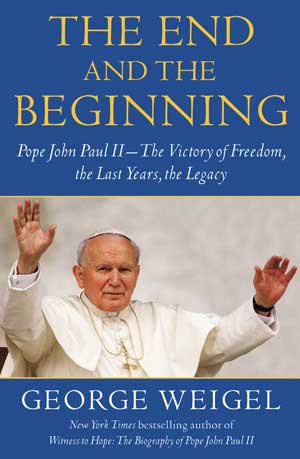
"The End and the Beginning: Pope John Paul II – The Victory of Freedom, the Last Years, the Legacy" by George Weigel. Doubleday (New York, 2010). 565 pp., $32.50.
Pope John Paul II was complex and nuanced as a man and as head of the Catholic Church. So were the world's political situation and the church's internal dynamics when Karol Wojtyla was elected pope in 1978.
He was a key figure in the collapse of the communist-ruled Soviet empire and he set the church's tone for almost 27 years, orienting its activity through the end of the 20th century and into the new millennium.
As the first non-Italian pope in more than four centuries, he brought a new outlook and a cultural framework to the Vatican for understanding and configuring Catholicism. Coming from communist-ruled Poland, John Paul also brought an urgency to the struggle for religious, political and personal freedom in the Soviet bloc. Added to this was his astute personal experience in living under – and negotiating with – communist leaders, making him a wily political strategist in the end game leading to the crumbling of the Iron Curtain.
NEW YORK –– Take the intensity of "Raging Bull," add a dose of "Rocky" inspiration, and mix in the tawdry family squabbles featured on TV's "The Jerry Springer Show" and you have "The Fighter" (Paramount), a fact-based drama that follows two half-brothers from Lowell, Mass., who long for fame – and redemption – via the boxing ring.
The siblings are Dicky Eklund (Christian Bale) and Micky Ward (Mark Wahlberg). Micky idolizes his older brother, the "Pride of Lowell," who once had his big shot as a welterweight boxer, going 10 rounds with the great Sugar Ray Leonard.
But the years have not been kind to Dicky, who has been on a self-destructive binge of drugs and loose women, all the while promising to mold Micky into the next world champion.
I never expected this call. In fact, around 3 p.m., Thursday, Dec. 23, I sent my insurance company the paperwork [...]
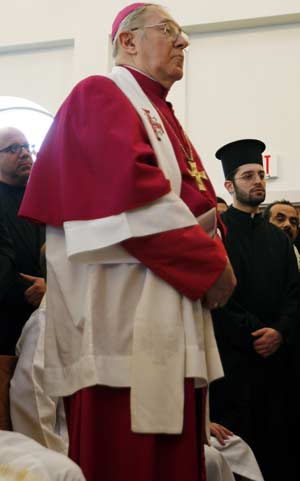
Bishop Richard J. Sklba stands next to a representative of the Coptic Orthodox Church Feb. 5, 2008, when Pope Shenouda [...]

Their similarly laid-back styles has made working together a smooth process, according to Sharon Krueger, Bishop Richard J. Sklba’s secretary [...]