
Since 2018, St. John the Baptist Parish, Plymouth, and St. Thomas Aquinas Parish, Elkhart Lake, have supported ZeruZeru and the Mary Mother of God Perpetual Help Center in Tanzania through a formal twinning relationship. In August, seven parish members had the opportunity to see the fruits of that work firsthand during a visit to the center.

Diane Gafney shares a joyful moment with children during an immersion pilgrimage to Tanzania, where relationships formed through parish twinning reveal the shared mission of the universal Church
ZeruZeru Simama Sasa was founded as a U.S.-based 501(c)(3) nonprofit in 2013 by Eric and Dr. Karene Boos, then parishioners of St. Thomas Aquinas, after years of mission work in Tanzania showed them the prejudice and persecution faced by people living with albinism. “ZeruZeru,” meaning “ghosts,” is a slur long used against people with albinism in Tanzania; paired with “Simama Sasa,” Swahili for “stand up now,” the name reclaims the term as a call for dignity.
Albinism is more common in Tanzania than in many other parts of the world. Estimates suggest about 1 in 1,400 people there have the condition, compared with about 1 in 20,000 in Europe and North America. Children with albinism face discrimination as well as grave danger from “witch doctors” and their followers, who believe the body parts of people with albinism hold magical or healing powers.
“When we saw what was happening to Tanzanian children with albinism, we had to do something, so we formed ZeruZeru and established a partnership with Sr. Helena Ntambulwa and the Mary Mother of God Perpetual Help Center in the small village of Lamadi to protect children with albinism,” said Karene Boos.
Today, more than 70 children are cared for by 20 staff members under the direction of Sr. Helena. In addition to children with albinism, the center is home to children who are orphaned or who have physical disabilities and have experienced discrimination or abandonment.
Karene Boos said the twinning relationship with SJB and STA has helped pay for staff salaries, food, medical care and school fees, as well as infrastructure projects including a dormitory, bathrooms, an adoration chapel and, most recently, a grotto dedicated to the Virgin Mary.
“We continue to raise money and make improvements, which we could not have accomplished without the generosity of parish members,” she said. “Our long-term goal is to move to a self-sustaining model, and the parish has helped fund a project to raise chickens to sell at market, renovations on our guest house and early business development planning for a small restaurant for visitors coming to and from nearby Serengeti National Park.”

Vivian Kesler of St. Thomas Aquinas Parish in Elkhart Lake visits the Mary Mother of God Perpetual Help Center in Tanzania, which cares for more than 70 children, including those with albinism or disabilities, or who have been orphaned. (Submitted photo)
Seeing the work firsthand
Seven parishioners from the two parishes spent two weeks in Tanzania in August, joined by five supporters from other parishes. Karene Boos served as host, with support from Dr. Antoinette Mensah, Director of the Archdiocese of Milwaukee’s Office for World Missions.
The group spent five days at the center in Lamadi, delivering seven suitcases of clothes, playing cards, puzzles and art supplies donated by parishioners. They also brought bandanas, sunscreen and sunglasses donated by local businesses. Because albinism reduces pigment in the skin and eyes, children with the condition are extremely sensitive to the sun, and most have some degree of visual impairment.
“In advance of the trip, we worked with Karene to organize a supply drive to collect needed items for the children,” said Kathy Halloran, co-leader of the ZeruZeru ministry. “We have such a giving community, and what parish members and local businesses donated was overwhelming.”
The visitors helped prepare for and took part in a dedication Mass and blessing for the newly built Santa Maria Maggiore grotto, which was partially funded by parish donations. The bishop of Bariadi dedicated the grotto during a celebration that included Marian hymns sung by the children.
During the visit, the group led the children in praying the rosary, which was livestreamed to parishioners at home before a weekday Mass. They also played soccer, taught the children card games and learned a few in return, and shared in daily life at the center.
“When I first heard Karene speak, I knew I had to be part of this committee. I told my family that these kids are like my students and someday I will go there! It took nearly 10 years, but ‘someday’ finally arrived,” said Diane Gafney, ministry co-leader and a specialist who works with visually impaired students in the Sheboygan Area School District.
Halloran added, “I’ve been passionate about supporting ZeruZeru from the beginning, but to travel to Tanzania to meet Sr. Helena and hug the children I’d seen only in photos brought me great joy. We are making a real difference in the lives of people living in a very different culture with human needs just like ours.”
Ministry includes solidarity, spiritual support
The twinning relationship was formalized in 2018 with the approval of then-pastor Fr. Phil Reifenberg and a partnership covenant approved by the archdiocesan mission office. A small team then began organizing activities around four goals: financial support, education about albinism, relationship-building between cultures, and the development of a “mutual faith community, separated by miles, united by love and supported with prayer.”
Early efforts focused on the annual mission appeal, with Karene and Eric Boos visiting the parishes to share updates from the center and ask for continued support. Their visits included talks and after-Mass socials featuring solidarity meals of beans and rice, Tanzanian coffee and a silent auction of Tanzanian items.
The ministry soon grew to include regular events. Members promote International Albinism Awareness Day (June 13), take part in the archdiocesan World Mission Sunday celebration, and give educational presentations to local organizations. Students at St. John the Baptist Grade School exchange pen-pal letters and prayer intentions with the children at the center, and prayer cards with the children’s names and photos invite parishioners to pray for them by name.
Each year, the ministry also hosts “Dining in the Dark,” a meal that gives attendees a taste of eating with limited eyesight and fosters solidarity with people who live with albinism-related visual impairment.
Strengthening parish community
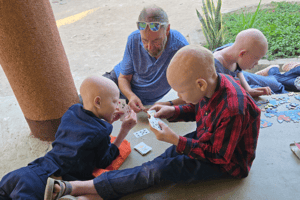
Dennis Halloran of St. John the Baptist Parish in Plymouth was among the parishioners who traveled to Tanzania in August to visit children supported through the parishes’ ZeruZeru twinning ministry. (Submitted photo)
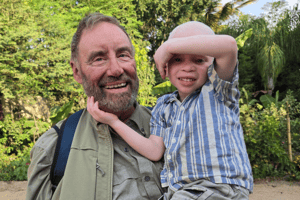
Dennis Halloran of St. John the Baptist Parish in Plymouth was among the parishioners who traveled to Tanzania in August to visit children supported through the parishes’ ZeruZeru twinning ministry. (Submitted photo)
Next month, the ZeruZeru committee will host a brunch at which Karene Boos and ministry members will share stories from the trip. With the continued support of current pastor Fr. Subi Thomas, the team is planning its 2027 priorities, including presentations to SJB students and other local church groups, promotion of International Albinism Awareness Day, and possible future cultural immersion trips.
“We are always learning through this ministry, and although our focus may change through the years, one thing remains the same: We want parishioners to understand what life is like for people with albinism in other cultures and the challenges they face,” Gafney said.
The twinning relationship has brought other blessings as well. “Partnership between the two parishes began more than a decade ago with sharing a priest, and this ministry has helped strengthen our relationship and given us a meaningful ministry project to unite around,” Halloran said.
Parish Twinning: What Is It?
Parish twinning in the Archdiocese of Milwaukee is a parish-led initiative; each parish makes its own twinning decisions.
The process usually begins when a parish identifies a potential partner and then approaches the Milwaukee Archdiocesan Office for World Mission for guidance.
“Our office is always available to guide parishes through foundational protocols and processes, as we did when St. John the Baptist and St. Thomas Aquinas established their twinning relationship with ZeruZeru, but the initiative itself always originates at the parish level,” said Dr. Antoinette Mensah, OWM Director.
Many parishes in the archdiocese have a partnership with a parish, village or community in another part of the world. A true twinning relationship, however, goes beyond financial support: It is a mutual partnership of support, prayer and solidarity that includes personal encounters and is rooted in Catholic social teaching.
According to the Principles of Twinning Handbook, available through the OWM, the relationship should deepen parishioners’ awareness of and compassion for underserved and disadvantaged people. The principles of twinning “invite parishes to see twinning not as a project to be managed but as a relationship to be lived — one in which both partners encounter Christ in each other, walk together, and are mutually transformed.”*
For more information on parish twinning or to begin a partnership, contact the OWM at 414-758-2280 or visit worldmissionmke.org.
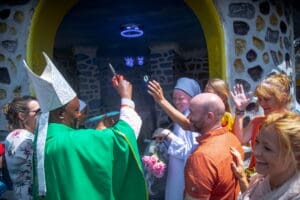
The bishop of the Diocese of Bariadi dedicates the new Santa Maria Maggiore grotto at the Mary Mother of God Perpetual Help Center in Lamadi, Tanzania, in August. Donations from St. John the Baptist and St. Thomas Aquinas parishes helped fund its construction. (Submitted photo)
