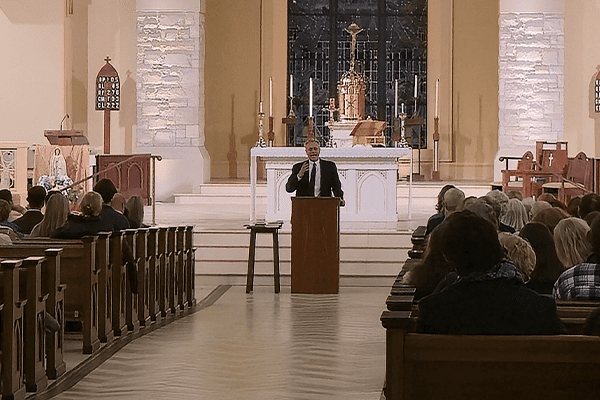
Dr. John Bergsma speaks on “Confession as Spiritual Warfare” to a crowd during his presentation at St. James, Mukwonago, on Feb. 14, encouraging Catholics to view the sacrament as a source of freedom rather than judgment. (Submitted photo)
For some Catholics, stepping into the confessional can feel less like entering a place of healing and more like entering a courtroom, where every fault is exposed for judgment. During a recent visit to southeastern Wisconsin, biblical scholar Dr. John Bergsma encouraged a different perspective — one that reflects the sacrament’s biblical roots and its true purpose.
Speaking over two evenings to more than 500 people, Bergsma offered a compelling reframing: Confession is not about shame. It is about freedom. His presentations, hosted at St. Jerome, Oconomowoc and St. James, Mukwonago, came providentially as Lent got underway and the Archdiocese of Milwaukee prepares to offer a Day of Reconciliation later this month.
For Catholics considering a return to the sacrament this season, Bergsma offered reassurance: The confessional is not a chamber of condemnation but a place of grace, healing and restored joy.
Currently a professor of theology at Franciscan University of Steubenville and vice president for Biblical Theology and Mission Effectiveness at the St. Paul Center for Biblical Theology, Bergsma is also a former Protestant pastor who entered the Catholic Church in 2001 while completing doctoral studies in the Old Testament and the Dead Sea Scrolls at the University of Notre Dame. His own journey into Catholicism was shaped in part by his study of Scripture — and by his growing conviction that the Sacrament of Reconciliation is deeply biblical.
During his talk, “Confession and Spiritual Warfare,” Feb. 14 at St. James, Bergsma shared a pivotal moment when he was preaching through the Letter of James as a young Protestant minister. When he reached James 5:16 — “Confess your sins to one another and pray for one another, that you may be healed” — he was struck by the absence of any structured, confidential practice of personal confession in his community.
“We acknowledged sin in general ways,” he said, “But we didn’t have a practical way to obey that verse.”
In contrast, he came to see the Catholic sacrament as a concrete and faithful response to Scripture. He also pointed to John 20:22-23, in which the risen Christ entrusts the apostles with authority to forgive or retain sins, and to Old Testament precedent in Leviticus, where confession to a priest accompanied sacrificial offerings. Confession, Bergsma said, isn’t a modern Church invention but a fulfillment of patterns established throughout salvation history.
Reclaim Your Freedom
Beyond its biblical foundation, Bergsma invited listeners to reconsider how they imagine the sacrament itself.
“Confession is often thought of in legal terms,” he said, “as though you’re stepping into a courtroom to receive a verdict.”
Drawing on his pastoral experiences, including encounters with individuals struggling with serious sin and spiritual oppression, Bergsma described how thorough, sincere confession often preceded profound spiritual freedom. Sin, he explained, gives the enemy a kind of foothold. In confession, that foothold is revoked.
Using a modern analogy, he compared sin to accepting “cookies” online that grant access to one’s device. Periodically clearing those cookies restores control. Similarly, confession removes the permissions granted through sin, restoring spiritual clarity and strength.
“It’s a liberation chamber,” he said, not a place of humiliation but of renewed freedom.
The Reality of Habitual Sin
A common discouragement for many Catholics is the experience of confessing the same sins repeatedly. Bergsma acknowledged the frustration but offered perspective.
“If you’re confessing the same sins,” he said, recalling a confessor’s advice, “at least you’re not committing new ones.”
He compared the struggle to “stable disease” in medical terms: while not yet healed, the situation is not worsening. He also encouraged Catholics to examine the roots of recurring sins — whether a past wound, trauma or early exposure — and to seek spiritual direction when possible.
He strongly recommended regular confession — at least monthly — and echoed the advice of spiritual masters who encourage annual retreats with general confession, and even more frequent reception of the sacrament for those battling persistent habits.
An Invitation this Lent
With the archdiocese’s Day of Reconciliation on the horizon — an opportunity to receive the sacrament at 11 parishes throughout the Archdiocese of Milwaukee all day March 25 — Bergsma offered particular encouragement to those who haven’t been to confession recently or for years.
“Don’t be intimidated, he said. “Priests have heard it all before. You are not that original.”
For priests, he likened the experience to that of the prodigal son returning home.
“If you’ve been gone a long time, you’re going to make a very happy priest,” he said, noting that no sin is too shocking and no return is unwelcome.
For those unsure how to begin, his advice is simple.
“Tell the priest how long it has been and ask for help,” Bergsma said. “Most priests will be happy to help you.”
As Lent unfolds across southeastern Wisconsin, Bergsma’s message resonates clearly: Confession is not about rehearsing shame. It is about reclaiming freedom. The confessional door is open — not to condemn, but to restore.
Find details for times and parishes here for parishes offering confession during the Archdiocese of Milwaukee’s Day of Reconciliation on March 25.
To watch Dr. Bergsma’s talk, “Confession as Spiritual Warfare,” and explore additional resources, visit johnbergsma.com.