At the age of 85, Patricia Belger did something that many people half her age wouldn’t have the courage to do: She packed up her life and moved halfway across the
country.
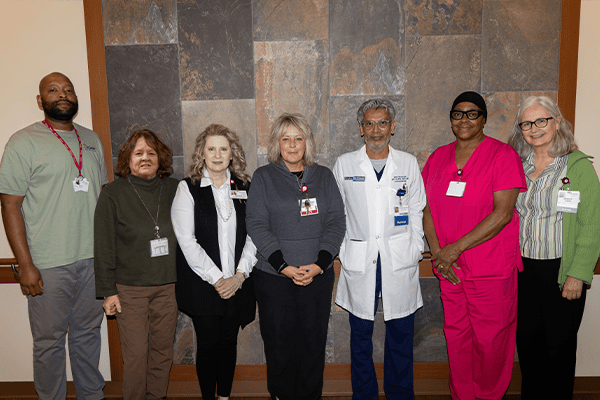
The St. Camillus Hospice team—which includes nurses, social workers, physicians, volunteers and a chaplain, working together to provide compassionate care and support. (Submitted Photo)
The longtime Philadelphia resident had never married and had no children. When she asked her nieces, Pat Ostermick of Milwaukee and Terri Vetter of Madison, to act as her healthcare powers of attorney, the women readily agreed — but they were honest, too.
“We did say to her, ‘Aunt Pat, we can’t do this long distance. So, when the time is right on your end, we hope you take advantage of coming earlier rather than later, so you can come join a community and be part of things and be a part of our families,’” said Ostermick.
Moving into independent living facilities at St. Camillus, Belger quickly became a beloved fixture — “Pat from Philadelphia” — who showed up unfailingly to daily Mass and could always be counted on to bring Hershey’s Kisses to bingo.
As her health declined, Belger moved into St. Camillus’ assisted living facility. When it became apparent that she did not have long to live, St. Camillus was able to provide hospice services at her assisted living apartment.
When the priest who came to administer the Anointing of the Sick began to pray over her, Belger made the sign of the cross. It was the first time in a few days that she had been responsive to those around her.
“She knew she was getting that sacrament,” said Ostermick. “She knew Father was there.”
Patricia Belger passed away Nov. 14, 2025, with her nieces at her side. Even now, almost a year later, Ostermick remains moved by the experience of her aunt’s last decade.
“She felt that she was surrounded by people who were as old as she, but that there was life in all of them,” said Ostermick. “And they still had a chance to be of service and grace and supportive of each other.”
Belger’s experience is not an uncommon one, said Barbara Freres, Hospice Chaplin at St. Camillus.
“The spiritual life can blossom at this stage,” she said. “When there is suffering at the end of life, the Christian faith offers meaning and great consolation.”
Catholic teaching on end-of-life issues emphasizes the value of the human person even when they are no longer self-sufficient or “productive” in the economic sense, said Freres.
“Being with those who don’t fit into this culture of efficiency and productivity is a real privilege,” she said. “Praying or simply remaining with a loved one who is dying can convey to them that their life is valued and sacred — even though they may not be able to think clearly, communicate, walk or do anything on their own.”
This philosophy is contrary to what Pope Francis termed the “throwaway culture” of modern life, said Freres: “But it is what our faith is all about.”
What does the Church teach?
If Dr. Tim Jessick’s 30 years of treating hospice patients have taught him anything, it is this: A human being is more than the sum of his or her parts.
“This is not just someone that has a liver or a lung,” said Dr. Jessick, who serves on the Archdiocesan Bioethics Committee. “This is someone that has a soul.”
Dr. Jessick’s career in medicine began in family practice. He wanted to be able to follow patients throughout life, from birth to death, and to be there for everything in between. In 1995, he treated his first hospice patient, and as the medical landscape shifted throughout the years, Dr. Jessick realized that the emerging specialty of palliative care offered him an opportunity to truly embrace what he calls “patient-centered medicine.”
“We’re very, very good at being ‘physician-centered,’” said Dr. Jessick of contemporary medical best practices. “You have pneumonia in your lung. This is what the chest x-ray shows. Here’s what the labs show. That’s a very physician-centered approach.”
It’s adequate, but it’s not enough, and it doesn’t reflect the dignity of the patient’s humanity. It doesn’t answer the question that Dr. Jessick has, as a faithful Catholic, about the patient sitting in front of him: “How do I see Jesus in this person? How do I accompany you through this journey, even after my treatments have failed? How can I be humble enough to know that I don’t have all the answers?”
Dr. Jessick finds a roadmap for unpacking the complexity of human dignity in the twilight of life in resources like the United States Conference of Catholic Bishops’ Ethical and Religious Directives for Catholic Health Care Services and the Wisconsin Catholic Conference’s pastoral letter, “Now and at the Hour of Our Death.”
These documents emphasize the inviolable dignity of every human being and promote a practice of moral medical decision-making that upholds and affirms that dignity.
Too often, Catholics avoid these teachings because death is, understandably, an uncomfortable subject to confront. Just as often, said Dr. Jessick, they possess a flawed understanding of them.
“Case in point, someone may say — ‘Well, my grandma is on a ventilator. I can’t even consider taking her off a ventilator because that’s euthanasia. I’d be killing her. That’s a sin,’” said Dr. Jessick.
But that black-and-white thinking is simply incorrect: The Church calls for “ordinary measures” to be employed to maintain life, but those measures can look different in different scenarios. In fact, the Church allows for — and encourages — robust examination of mitigating factors in determining the best decision for each patient.
“It really comes down to taking the time to slow down and carefully discern the whole situation,” said Deacon Rich Fedor, Director of the Archdiocese of Milwaukee’s Respect Life Ministry.
Prior to his current ministry, Deacon Fedor was a hospice nurse for many years.
“Can we always get suffering and pain down to nothing? No, but there are plenty of interventions and resources available to minimize it as much as we can,” he said.
Both Deacon Fedor and Dr. Jessick feel that creating dialogue and awareness around these teachings is a critical step to creating a more dignified, “person-centered” process — one similar to that experienced by Pat Belger and her family.
“The hospice people were incredible, not only for her but for us, in this process,” said Ostermick, who emphasized the contributions not only of the on-staff caregivers but the pastoral team as well. “Her whole being was cared for, not just her body.”
After Belger’s death, as her body was being removed from the St. Camillus campus, Freres and other hospice workers covered it with a homemade quilt. A procession accompanied her body’s journey through the halls.
“All these people had contributed to her care, and respected her as a person, and they lined the halls,” said Ostermick. “We knew we weren’t alone.”