
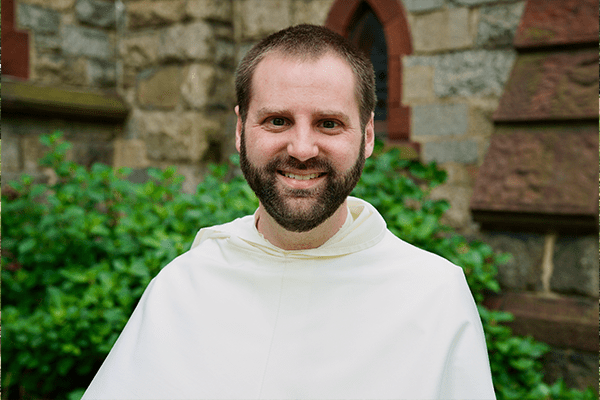
Fr. Columba Thomas, O.P., a graduate of Yale Medical School and a Dominican priest, offered his perspective on suffering and hope at the Converging Roads conference. (Submitted photo)
Fr. Columba Thomas, O.P., has seen his fair share of suffering. As a physician specializing in internal medicine, he has cared for patients nearing the end of their lives, overwhelmed by suffering in body, mind and spirit.
But as a Dominican priest, he has also witnessed the unique ways in which a life lived in grace can transform suffering into sanctification — and even hope.
Fr. Thomas, an assistant professor of medicine at the Georgetown University School of Medicine and a chaplain with Dominican Healthcare Ministry, reflected on these themes at the Converging Roads: Hope in Health Care conference Nov. 8 at Marquette University, Milwaukee.
In his talk, titled “Hope and the Redemptive Meaning of Suffering,” Fr. Thomas pointed out that every human person “is called to holiness, no matter where they’re coming from, no matter what their current state of life is.”
“We all have the dignity of being loved by an infinite God and being given, at some point in our lifetimes, at least one offer of saving grace,” he said. “That applies to every single person who has ever walked on this planet — not just the ones that we recognize as of the Christian faith.”
Suffering, likewise, is a universal phenomenon, one whose origins can be found in the Garden of Eden and the fall of man — and it was never part of God’s plan for the human experience: “In faith, we understand suffering as a consequence of original sin,” he said.
If every person knows what it is to suffer, and every person has the opportunity to experience grace, then every person — no matter their situation — also has the ability to cultivate that holiest and most mysterious of virtues: hope, which is born from the interaction of suffering and a soul enriched by God’s grace.
Paraphrasing St. Thomas Aquinas, Fr. Thomas said that the theological virtue of hope “is a movement of the will by which a person seeks union with God and eternal life, trusting that God will provide the means to attain these things, however arduous or difficult.”
“There’s a very lofty purpose and meaning to these vulnerabilities and sufferings if we unite ourselves to Christ in grace,” he said.
Fr. Thomas pointed out that on several occasions Jesus Christ referred to himself as a physician (Matthew 9:12, Luke 5:31), indicating that “the bodily and psychological healings that he performed were signs of a deeper and more lasting healing that only he could provide: that of eternal life with him, and the promise of complete restoration of body and soul in glory at the end of time.”
The practice of medicine is remarkable, said Fr. Thomas, because “its primary goals are to address some of the basic effects of original sin … to cure and to preserve life, yes, but also to comfort, to maintain function.”
He called on Catholic health care providers to focus on growing in virtue, which he defined as “dispositions or habits of the soul that allow us to act rightly in accord with reason, across a wide range of scenarios.”
“Virtue is very freeing,” he said. “It perfects our human nature. It transforms us so that we are prepared to act well and in accord with right reason, across a whole range of different situations that we might find ourselves in.”
Fr. Thomas attended Yale School of Medicine and completed residency and chief residency in the Yale Primary Care Program before joining the Dominican Order in 2016.
Medicine, Fr. Thomas said, is more than a profession — it is a vocation. He quoted Edmund Pellegrino, M.D. and David Thomasma, Ph.D., authors of many well-known writings on medicine and ethics, who described a vocation as “a call by God to transmute a profession into the domain of grace and charity.”
“What does that entail?” asked Fr. Thomas. “(It means) we are conformed to God in grace. We participate in the life of God, so that even our everyday acts, even when we don’t realize it, can be a source of hope to others and a witness to the Gospel.”
Presented by the St. John Paul II Foundation, the Archdiocese of Milwaukee and the Milwaukee Guild of the Catholic Medical Association, the Converging Roads medical ethics conference included talks on the intersection of faith, ethics and medicine, along with Mass, the Sacrament of Reconciliation and time for fellowship and discussion.
Specifically created to provide an opportunity for Catholic health care providers and students to experience spiritual and professional enrichment, the conference was also open to clergy and the public.
For more information on Converging Roads, visit forlifeandfamily.org. For more information on the Milwaukee Guild of the Catholic Medical Association, visit mgcma.org.
