
Catholic bookshelves are filled with written and illustrated catechisms offering instruction of the faith. But if you look to the Greek etymology of the word “catechesis,” it becomes clear that, in its truest sense, catechesis is something spoken. It is a sound.
An echo.
In her keynote address Aug. 21, the first day of the Archdiocese of Milwaukee’s annual Catechetical Conference, Julianne Stanz told catechetical leaders that their work is “to be an echo of God’s voice and his teachings in the Body of Christ, the Church.”
“This is the calling of our lives,” Stanz told her audience gathered at the Mary Mother of the Church Pastoral Center in St. Francis. “I don’t know about you, but I wouldn’t work this hard for any other business, any other organization, anything else. The greatest calling on our lives is to share the Good News.”
At the same time, she acknowledged that catechists can get discouraged in their ministries at times. “You are doing the toughest work, often the most thankless work. You are the first people that are at the parish in the morning and often the last ones to turn off the light.”
But there is no work more important, she told those gathered for the conference, which featured a theme this year of “Beacons of Hope.”
Stanz is the director of outreach for evangelization and discipleship at Loyola Press and is a consultant to various committees with the United States Conference of Catholic Bishops including the Eucharistic Revival. She previously worked as director of parish life and evangelization for the Diocese of Green Bay, and has authored several books, most recently “The Catholic Parents’ Survival Guide: Straight Answers to Your Kids’ Toughest Questions.”
A native of Ireland, Stanz now resides in Algoma with her husband and three children.
Despite her current ministry, Stanz’s background is “cultural Catholicism at its finest,” she said.
“I grew up in a home that went to Mass on Sundays but never prayed at the table. I grew up in a family where the Scriptures were never opened. I never saw a Bible throughout my entire childhood,” she said. “But we were very Catholic.”
Missionaries of the thin places
Stanz was young when she participated in a school pilgrimage to Croagh Patrick — a destination for pilgrims from all over the world for more than 1,000 years due to its legendary association with St. Patrick.
As Stanz made the climb to the mountain’s peak, the priest accompanying the group “started talking about Jesus and about Mary like they were right beside me.”
“That was the first time I ever heard anybody talk about the Blessed Mother and Jesus like they were real,” Stanz said. “And something started to change inside of me.”
At the top of the mountain, she said her first real prayer. A prayer of the heart.
Later, when she told the priest about her experience, he told her: “This is a thin place.”
“Thin place” is an Irish term, rooted in Celtic spirituality, used to describe any place where the divide between heaven and Earth is particularly hard to discern — “where God,” Stanz said, “is literally trying to break through … to communicate his love for us.”
“Marriage, death, dying, hospital ministry, pastoral care,” she said. “They are thin places where God is trying to communicate himself.”
The thin places of life form the mission field of the catechist.
“When you prepare children to receive their first Eucharist, it should be a thin place for them,” Stanz told the conference. “We prepare children to be tabernacles with feet, where they walk the presence of Jesus out into the world … (but) they first need to know how much they are loved by God in these thin places of their lives.”
Being, knowing, doing
Stanz cited the new Directory for Catechesis published by the Vatican, which advises that the three dimensions of a catechetical leader are “being, knowing and doing.”
“We spend a lot of time in our ministries trying to tell people about what they should know about the Catholic Church,” Stanz said. “But it is in the being that most of our parents and our kids struggle. And so being is where we need to spend a lot of our time.”
Stanz had heard the echoing of the church bells at her home parish of St. Brigid’s every day of her life, but their meaning did not register — until the day at Croagh Patrick, when, in Ireland’s thinnest place, she heard the voice of God, and a relationship began.
“Our way of echoing the Church needs to be profoundly relational in style. Programs do not form disciples. People form disciples,” she said. “We are disciples of a person. The name of that person is Jesus.”
Stanz will return to the Milwaukee area in November to speak at the Women of Christ conference in Brookfield. For more information, visit womenofchrist.net and juliannestanz.com.
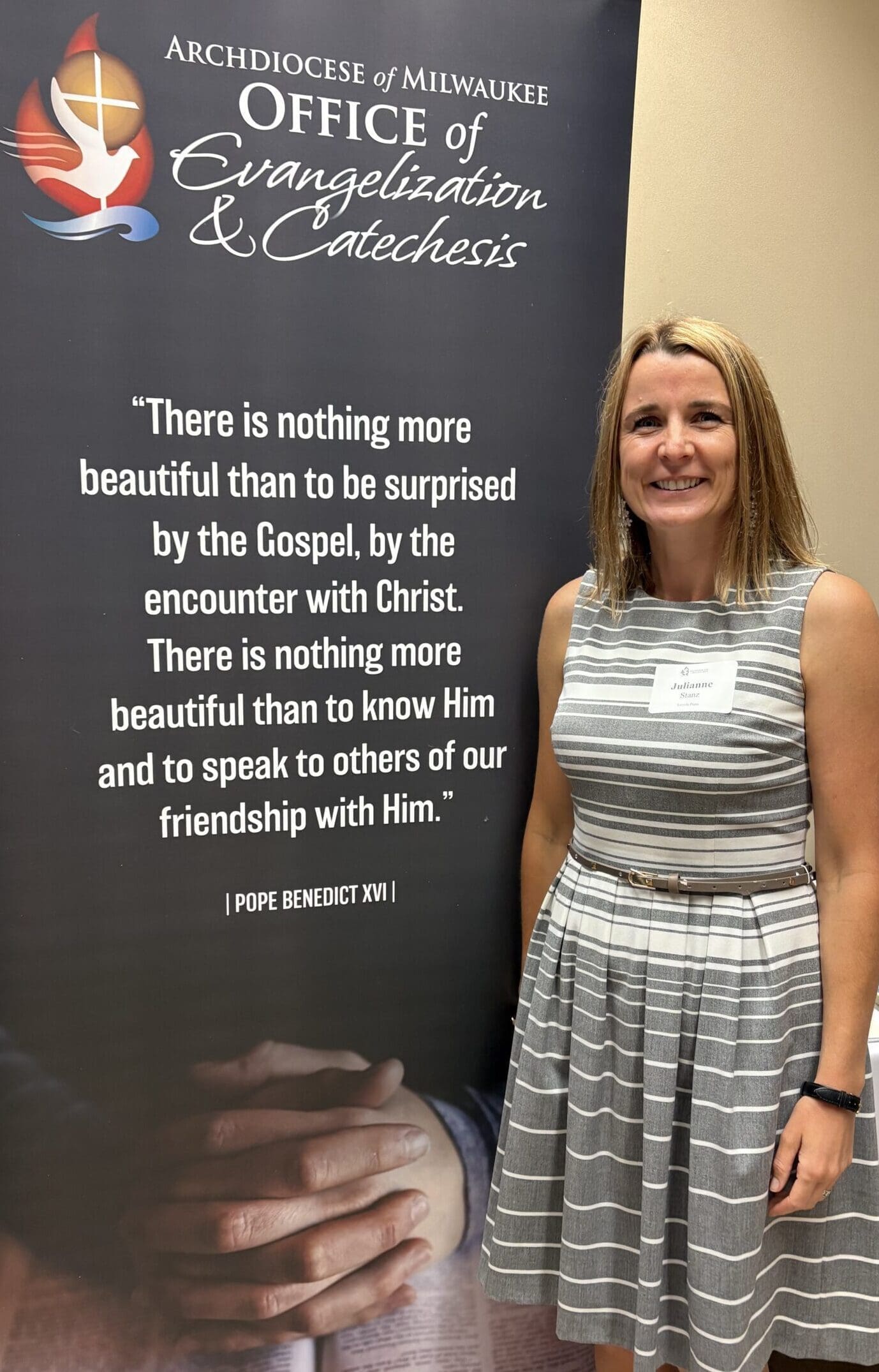
Julianne Stanz was the keynote speaker for the Archdiocese of Milwaukee’s annual Catechetical Conference at the Mary Mother of the Church Pastoral Center in St. Francis, Aug. 21-23. (Photo by Colleen Jurkiewicz)
