
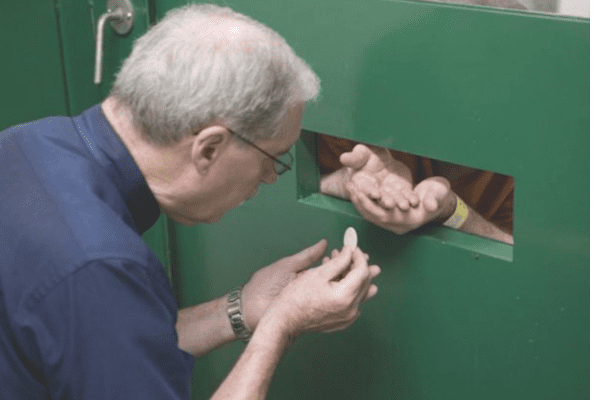
A priest distributes Communion to an inmate in solitary confinement in this undated photo. Dismas Ministry brings the sacraments and spiritual support to incarcerated people, reflecting the Church’s call to accompany those behind bars. (Submitted photo)
Most people know the story of the good thief whom Christ promised would join him in paradise while suffering on the cross for our sins and opening the door to heaven for us. Most of us don’t know that thief’s name — or that he became a saint.
The feast of St. Dismas comes on March 25, and Milwaukee-based Dismas Ministry has been living a nationwide-ministry of healing and forgiveness for incarcerated brothers and sisters of faith for more than 25 years.
“It happened right there when Jesus was being condemned and crucified,” said Juliann Joerres, Dismas Ministry’s executive director. “Isn’t that what we do to people in this day and age? We tend to condemn them and crucify them, oftentimes before they’re even found guilty. And they have the opportunity to be forgiven. They have the opportunity to renew.”
Through correspondence, publications and pastoral support, Dismas Ministry reminds our brothers and sisters behind bars that they are not forgotten by the Church or by God.
The ministry has opened the door to renewal by helping both incarcerated people and the clergy and volunteers who minister to them receive publications like free Bibles, catechetical study books and courses, and other spiritual resources.
“We serve the chaplains, the ministers, the volunteers, the deacons and priests that go into the prisons and meet with people who want to receive Communion, who might be doing Catholic Bible study, might be doing any kind of meetings with people who are in prison,” Joerres said.
“We also have another population that we serve, directly to the incarcerated. Both populations can reach out to us directly to request the publications that we have.”
Joerres said that the ministry began in 1999 with Ron Zeilinger, who was working for Sacred Heart Seminary and School of Theology, Franklin, when he started getting requests for Catholic Bibles from prisoners.
“He realized that there were no organizations out there that were providing Catholic Bibles to the inmates. So he thought, ‘I can make that happen,’” Joerres said.
“He wrote for his first grant, received it, and then he started here in Wisconsin and in the surrounding areas.”
Joerres says that within a decade and a half, word of mouth and successful fundraising empowered the ministry to turn from one that served locally to one whose resources help people within the prison system in all 50 states, serving 10,000 to 12,000 Catholics each year.
In so many cases, their ministry catalyzes encounters that truly help prisoners feel like they’re being spiritually set free from their sin.
“It’s really an awakening. It’s a ‘coming home,’” Joerres said.
“It’s a feeling as if the Catholic Church hasn’t forgotten them. They may be away from society, locked up where people can’t see them, but they are still members of the Catholic Church. They deserve to be treated as members. They deserve to have our accompaniment.”
Joerres says the incarcerated people who receive the fruits of their materials feel “seen and heard for the first time in a really long time,” opening doors to an awakening and renewal of their faith.
“I have one minister who works out in Alaska, and she is a very old school Catholic, very ‘by the book.’ She said she was raised by nuns, and she’s teaching them the same way the nuns taught her,” Joerres explained.
“These guys know that when she comes in, she means business. When she tells them they need to go to confession first, they’ll go to confession. They turn around and they say, ‘No one has ever made me feel like my beliefs are important in prison.’ They’ve said, ‘It’s something that I’ve always wanted, but no one has made it available to me.’”
The Order of Christian Initiation of Adults materials that Dismas Ministry creates have opened countless doors to incarcerated people receiving the sacraments of initiation.
“The woman in Alaska called me last year and said, ‘I’m a new godparent. We just had three people get baptized in prison today, and I was the witness for them,’” Joerres said.
“Dcn. Gerald Gaenslen, who’s one of our deacons down in Texas, sent me a story of nine men who were just baptized recently and just brought their full communion into the Catholic Church. And they used Our Faith Study (one of their materials) as part of their study for the OCIA program.”
Joerres says the calling that the late Pope Francis, and now Pope Leo XIV, made to be present to people on the margins of society has given an extra jump start to their ministry, as it has empowered more prison ministry.
“We often call our ministry the forgotten work of mercy. Visiting the prisoner is a work of mercy, and it is something that people just don’t talk about. It’s not shared. You could be sitting in church and sitting next to someone who has been incarcerated or someone who has a brother, a sister, an aunt, an uncle, a nephew, a niece that is currently incarcerated,” Joerres said, voicing the need for prayer and for donations to help fund the ever-increasing need for Catholic materials to serve incarcerated individuals.
“We are called to reach out to those in need, to visit the imprisoned, to visit the sick, to do all of those things,” she said. “That’s living our lives according to the Gospel message. And it is a calling.”
