Faith. Family. Fun.
Last year, our family did the Jesse Tree.
For those who are unfamiliar, a Jesse Tree is an Advent activity that involves tracing Jesus’ lineage, following the history of salvation from Adam through Old Testament figures like Noah, Abraham and David. Reading along with the corresponding texts from Scripture, children make a different ornament for the Jesse Tree each day, and the activity culminates with the coming of the Messiah.
I had very grand plans for this. Finally, a simple way to help my kids connect the dots between the hope of the Gospel and the (slightly scary, let’s be honest here) Old Testament stories! Enthusiastically, I downloaded and printed three separate copies of ornaments the children were to color. I labeled and paper-clipped them. I kept all the materials together with our art supplies and our Bible, so we could easily grab everything and dive into the activity after breakfast each day.
We started strong with the Story of Creation. I read the brief Scripture passage while the kids colored the little planet Earth on their ornaments. I cut them out, labeled and laminated them, punched a hole in the top and laced it with a string. We hung them on the Christmas tree — “the first day,” as they say in Genesis.
The following morning, we moved on to the Garden of Eden. Color, read, laminate, hole-punch, string, tree — the second day. And behold, I saw that it was good. “We got this,” I thought to myself. “You are a good mom, Kate.”
Day three, Noah and the Ark. Here I started to field some theological questions: “If only Noah’s family lived, how did they find other people to get married and have babies?” inquired the eldest. “You told me we can’t marry our cousins or the babies will have diseases.” The hole puncher was missing.
Day four. The Tower of Babel goes … well, about as well as the actual Tower of Babel went. “Why did God totally wreck what they were trying to do?” the middle child demanded. A squabble erupted over ownership of the brown marker. The eldest, a perfectionist, made a mistake in her coloring and demanded the whole thing be reprinted. The hole puncher was still missing.
Days seven through 10, everyone came down with colds. “No big deal, we’ll just double up on ornaments and finish strong by Christmas Eve,” I told myself. Day 11, the hole puncher was still missing, but now the string was, too, and the laminator ran out of pouches. The youngest lost her sheep ornament (Day six, the Sacrifice of Isaac) and became inconsolable.
Days 12 through 14 we forgot to do it. Day 15 we came back with renewed vigor, but my oldest cracked under the pressure. “There’s so much catching up to do,” she sniffed. “How am I going to finish it all?”
Day 16 we called it. Frances Family Jesse Tree 2024 died with a literal whimper: “I feel like we failed,” said the oldest.
“Well,” I told her. “I guess we kind of did.”
I struggle to help my children understand and accept failure because I myself have never learned to. I know a lot about failure, of course — don’t we all? — but I’m still not very good at it.
As I write this, Advent is once again staring us in the face. A few weeks ago, the oldest asked me: “Hey, can we do that thing again this Christmas? The Jesus tree thing. With the stories. And the coloring.”
“The Jesse Tree?”
“Yeah! That was so fun.”
“I guess,” I said. “If you want to. It didn’t go too well last year.”
“I liked it,” said the middle one.
Pride. That’s it — the reason I’m not good at failure, for all my experience with it. I don’t like owning up to a thing that’s gone wrong, or even a thing that’s just gone differently than I had hoped. I don’t like examining it, because it wounds my pride. After all, I had different plans.
But what is the story of salvation, if it is not a story of failure — again and again and again — and a story of trying — again and again and again.
“Okay,” I agreed. “We can do it again.”
The Jesse tree does not thrive because of its branches. It thrives because of its roots.
Quietly, I took out my phone and Googled “explain Tower of Babel to kids Catholic easy simple.”

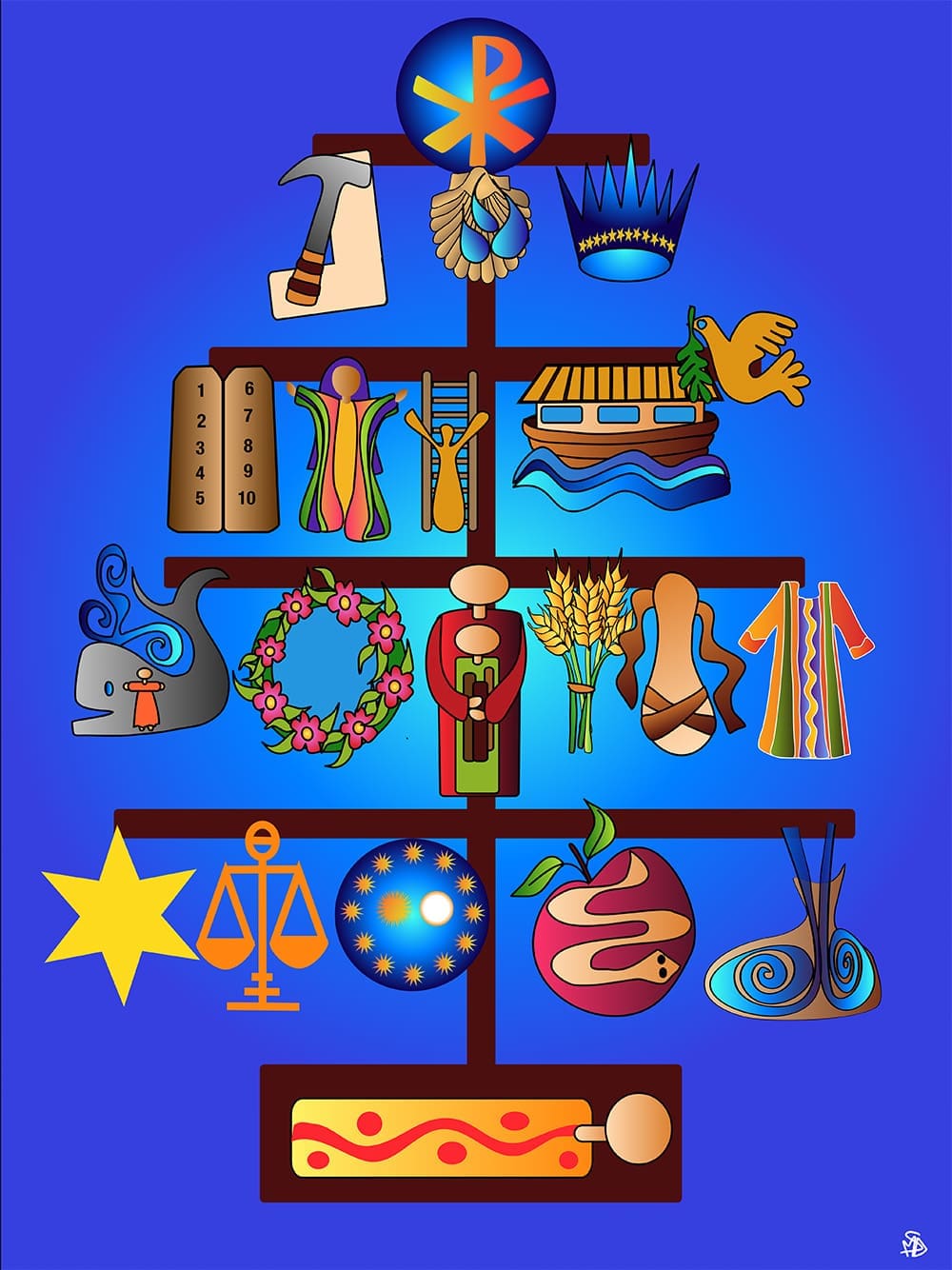
Image by Sr. Susan Daily, C.J., and used with permission.