
What do colleges and employers want from high school graduates? Along with strong academic skills, they want students who know how to put what they have learned into practice.
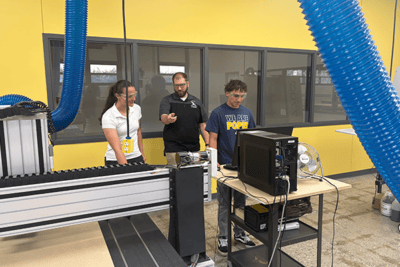
The new Applied Learning Lab at Pius XI Catholic High School features equipment including 3D printers and a CNC router, giving students opportunities to apply classroom lessons through hands-on learning. (Submitted photo)
Pius XI Catholic High School hopes to help students do just that with its new Applied Learning Lab, a hands-on learning space designed to connect classroom instruction with practical skills while incorporating the school’s Catholic mission.
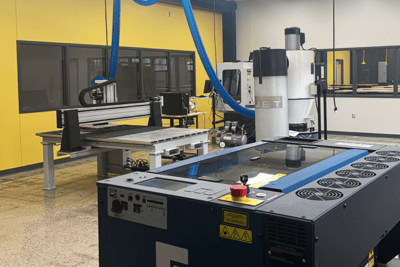
Adjacent to the school’s engineering classroom, the lab will include instructional and hands-on work areas equipped with technology ranging from 3D printers to a CNC router used for automated cutting, carving and drilling.
“It positions us as a school community in a way that I think we can have really attractive conversations with our students about ways they can come in and they can learn the essential skills,” said Pius XI President Tom Mlada. “They can also, in really new and exciting ways, apply those skills through hands-on learning opportunities, and those are essential.”
Pius aims to activate the proof of research that they say shows that when a theoretical concept is taught in an experiential way, the learner is more likely to retain the concept. The school sees the ALL as a way to bridge the knowledge and skill deficits that area companies and colleges like Marquette University and the University of Wisconsin are seeing.
“We went out to post-secondary institutions [and] asked really good questions about what the skills are that you’re seeing students come to you with, where the gaps are, and what we need to be doing better at the secondary level to better prepare for college engineering,” said Pius XI Vice President of Advancement Michelle Pape.
“We met with leaders at some of the high-level corporations in southeastern Wisconsin and said, ‘What are you looking for in your workers, and what is missing?’”
Former Pius XI President Jack Herbert and other school leaders saw in that feedback an opportunity to reconnect the school’s college-preparatory curriculum with its history of career and technical education, which was a focus at Pius XI from the 1960s through the 1980s.
“We started to take a closer look at how we can make sure that our students are not only college-ready but career-ready,” Pape said.
“We put together a steering committee about two years ago that really started to take a hard look at what it would take to build out the modern-day version of career and technical education that will serve our students well.”
The ALL has risen from those questions, and from the work of the alumni and school leadership to make it reality.
School leaders will begin by training faculty to use the lab’s technology and exploring ways to incorporate it into their courses. “It’s going to be able to be used by many of our different departments,” said Pius XI Principal Ryan Krienke.
“Students are learning how to program a robot that they will be able to manipulate with a variety of different electronic mechanisms. A lot of it is around programming, but they are going to be learning how to use different types of technology to have the robot be functional and do different things,” he added about one technology-centered course.
The technology won’t be limited to engineering and technical courses. School leaders also envision incorporating it into Pius XI’s Visual Arts program, an area for which the school has long been known.
“In my experience, taking engineering and art simultaneously has helped me develop as a creative problem solver. Engineering helps my art have structure; art helps my engineering have creativity. Engineering principles and art principles go hand-in-hand,” a 2023 alumnus said. “Art taught me to think of impossible solutions and engineering taught me how to make them possible.”
(Submitted Photo)
Because technology continues to evolve rapidly, Pius XI leaders expect the lab to evolve with it. The school is forming a community advisory group of professionals in medicine, higher education and industry to help identify emerging needs and guide the program’s development.
“People who work in the medical field, people who are working in higher education, people who are working in industry, and we’re trying to get as many people kind of up the ladder in those companies as possible to advise us as a school on where we should be thinking curricular-wise,” Krienke said. “We don’t see what they see out in the workforce.” Yet, ultimately, Mlada sees this new learning pathway as an invigorated avenue for helping young people move forward in their careers through the lens of the Catholic faith.
“We are all blessed with certain God-given gifts and it’s our responsibility to steward those gifts,” he said.
“We can help them build those gifts, identify and build those gifts so that they can then give back to their communities, to their families, in ways that take those gifts from God and then amplify those gifts in terms of their lifelong impact.”
