The best way to help neighbors in need is to meet them where they are.
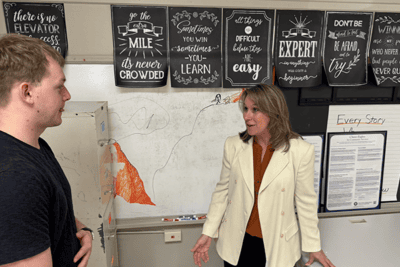
Annemarie Wood, principal at St. Mary Parish School, Menomonee Falls, speaks with a Catholic Charities therapist. St. Mary is one of three archdiocesan schools teaming with Catholic Charities on the School-Based Mental Health pilot program.(Submitted Photo)
With growing mental health needs among children and teens, placing counselors in schools can help make support more accessible to students and families.
At the beginning of this school year, Catholic Charities began a pilot program, School-Based Mental Health, at three schools in the Archdiocese of Milwaukee: St. Mary Parish School, Menomonee Falls; St. Frances Cabrini School, West Bend; and Marquette University High School, Milwaukee.
The program brings therapists into schools that may not otherwise have dedicated mental health counseling available to all students.
“We picked these three partly because of their strong interest and because they continue our mission of serving those who might not otherwise have access to care. We felt that all three of these schools were committed to the program and to supporting their students and families and would be supportive school teams for our therapists to work with,” said Liz Schuett-Davison, Catholic Charities director of community mental health.
As part of the program, Catholic Charities mental health therapists are in the schools on a weekly basis. Early response has been strong, with therapists’ schedules filling at all three schools.
“More and more schools have added school counselors to their staffing but they are hard to find and not all schools can afford to have someone on staff. We were one of the schools that has not been able to afford to do so, and Catholic Charities is making this possible. I am really looking forward to having a resource for our families when their child is struggling,” said William Waech, the principal at St. Frances Cabrini.
Annemarie Wood, the principal at St. Mary, said students are experiencing mental health challenges differently than they did before the pandemic.
“There were things that existed before, but now there was a different sort of team mentality between parents and home, where we were seeing differences, and how all the behavior was coming about, and coping mechanisms were all of a sudden challenged in a new way,” she said. “There are neurodiversity-related moments that are happening for students. There is autism and ADHD, but anxiety is showing up more and more. And students are feeling pressure from things that typically we had not seen as a pressure moment previously, and it’s a lot of the self-image that is coming out even at a very young age.”
The early response has underscored the need. Catholic Charities has heard from other schools seeking similar support and hopes to expand the program as resources allow.
“I would love to continue to expand this program over time. It truly offers a bridge for students who might not be able to receive services and for schools to better support their students,” Schuett-Davison said.
When support is available in the school building, students can receive help sooner, families face fewer barriers, and educators gain a partner in caring for the whole child. Alongside direct counseling services, Catholic Charities therapists provide consultation, training and mental health education for school staff, strengthening support for all students.