
Divine Savior Holy Angels High School’s lunchroom has become too loud. Dean of Students Rachel Fredricks is overjoyed to deal with it.
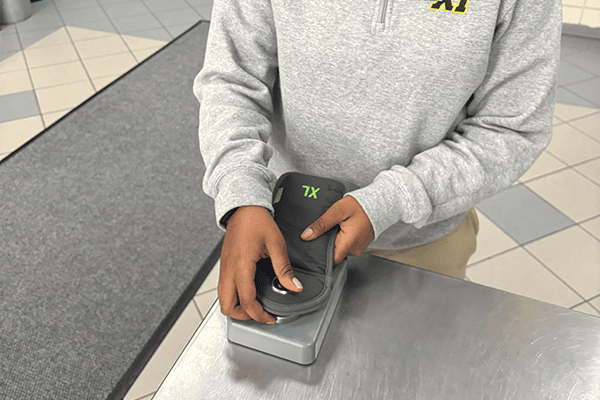
Pius XI students use Yondr pouches to secure their phones during the day. (Submitted Photo)
“When we moved to a full [cell phone] ban, the biggest complaint we got was that it’s too loud in the lunchroom now because the volume went up like crazy,” she said.
“I was like, ‘That’s great. I love this complaint.’ I love that this is the problem that we’re now facing, because girls are actually connecting with each other verbally and face to face and in person and not on their screens.”
It’s one effect of a move the school made two years ago, one that other Milwaukee-area Catholic high schools have similarly made to dramatically curtail cell phone use during school hours.
“From bell to bell, 7:50 a.m. to 3:05 p.m., cell phone use is not allowed in the building,” Fredericks said about DSHA.
For students like senior Madison Cotton, that means more attention on academics and friends and less on their phones.
“I find myself being more productive during lunch,” Cotton said. “I found myself being more talkative, more open and receptive to other people’s point of views, what they had to say and how their day was.”
It’s the kind of conversation that, when multiplied over hundreds of students in one room, creates a cacophony worthy of happy noise complaints.
The Catholic Herald reached out to every Milwaukee-area Catholic high school to ask administrators and students about their cell phone policies. Four high schools responded: Divine Savior Holy Angels, Pius XI and St. Thomas More in Milwaukee and Catholic Memorial in Waukesha.
The schools’ moves come amid a statewide public school policy signed into law in 2025 addressing student use of non-school-issued wireless communication devices during instructional time.
“The legislature is not allowing phones in schools, and teachers really love that,” said STM Principal Mark Nagle.
His school instituted a complete ban by changing their schedule and adding a homeroom period at the start of the day. Students put their phones in locked cubbies and retrieve them at dismissal time.
“Teachers don’t have any distractions to deal with, [and] it’s forcing students to work harder,” he said.
“Even the first day of school, we sat back and said, ‘Wow, it’s cool to see six kids at a table talking and interacting.’ They had no phones and they had no choice [but to] talk to each other.”
School President John Hoch also sees fewer mental health concerns related to the anxiety of continual attachment to devices, something he says has made kids’ lives worse.
“I just think we’re not in a good spot right now where we are socially with kids and their ability to communicate,” he said. “I’d see a table of about six kids and four of them are looking at their phones and maybe two are talking. And I really didn’t like seeing that.”
Since 2018, Catholic Memorial has also prohibited students from using cell phones during the school day. Phones must remain in backpacks or lockers between 7:25 a.m. and 2:40 p.m.
“Teachers have found that students are more focused and engaged in classroom conversations when they are not checking their phones or responding to notifications,” CMH President Donna Bembenek said. She said that some students had initial hesitation when the policy was rolled out, but that reluctance has subsided.
“I have become a more engaged student, which has allowed me to build stronger relationships with my teachers and peers,” said Ava Ohnmacht, a senior at CMH. “I also think being less focused on my phone has helped me stay more present and involved in my classes and everyday interactions.”
Pius XI students use Yondr pouches. Students turn off their phones and put them inside the pouches when they arrive at school. A faculty member uses a magnetic lock to secure each pouch, which remains with the student throughout the day. The phones are unlocked at the end of the day.
Principal Ryan Krienke said students are occasionally caught using their phones, as happens at schools with cell phone bans, but such incidents have become much less common.
“I interviewed two teachers this summer who asked me, before they would even accept an interview, what our cell phone policy was. They were coming from a public school that they felt [phone use] was completely out of control. They just said they didn’t want to teach in that environment,” Krienke said.
Pius XI senior Benjamin Tiedge sees what students might miss in their interactions with others when a screen continually commands their attention.
“They’re not only missing class, but they’re missing the time and things that they can do with their friends or the people around them or the clubs going on or the little interactions you have with people,” he said.
“I don’t think I’d want to experience high school with the phone.”
