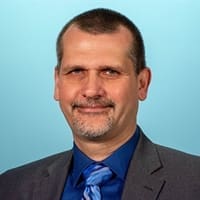
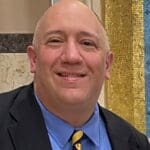
Bruce Varick has focused a good portion of his energies in recent years on making Milwaukee’s Catholic schools safe. Since 2017, in his role as associate superintendent for Catholic Schools, he has helped make learning environments more secure.
Now, Varick will be focusing his full energy on doing similar things for southeastern Wisconsin’s Catholic churches, beginning his new role as director of safety and security for the Archdiocese of Milwaukee on May 1. Yet he has already helped parishes across the area become safer while remaining welcoming houses of faith.
“My journey, and I think it parallels the journey of safety and security being an issue for schools and parishes, probably started in the 2017-2018 school year,” he said.
“In March of 2018, the Marjory Stoneman Douglas shooting event took place in Parkland, Florida. The Wisconsin legislature passed and the governor (signed) Act 143, which specifically deals with school safety issues. I was tasked with becoming the point person for monitoring that legislation and starting to look at ways that we could support schools.”
Since that time, Varick has drawn on nationally shared expertise and applied it in Milwaukee, helping archdiocesan schools implement measures to improve safety.
“The next real significant event that impacted the Catholic Church was the Annunciation shooting event in Minneapolis (that) happened in a church setting at Mass,” he said about the tragedy in August 2025.
“We had discussions here in various offices and ultimately up to Archbishop Grob. There was the recognition that there is a need for someone to be a primary resource for parishes and schools in the archdiocese.”
Varick says that the position reinforces the message that the Archdiocese of Milwaukee considers safety and security “an extremely high priority,” while doing it in the context of the mission of the Catholic Church.
“It means that we are welcoming and we respect the dignity of the human person,” he said.
“Anytime there’s a gathering of people that is in a little bit less controllable of an environment like a Sunday Mass, because we want to be welcoming people coming in, the risk goes up a little bit. What we want is to do reasonable things to address potential risk and to not only physically keep our parishioners safe, but also have them psychologically feel that they are safe in our worship environment and that they can be there to be a full participant in the Mass.”
Some recommendations that he helped parishes implement after Annunciation included a single point of entry into Mass when possible, and to have more ushers and hospitality ministers greeting people while keeping greater awareness of individuals in the vicinity.
“One of my tasks will be working with our parishes and their hospitality ministers [on] how to spot someone that may look a little bit out of place, or something not feeling quite right, and then [finding] an appropriate way to deal with it,” Varick said.
“It is about creating and increasing that awareness and then providing people with some basic things that they can do if they see something.”
St. Mary Parish in Hales Corners has implemented Varick’s recommendations alongside those of its safety committee, balancing security with a welcoming environment.
“We try to evaluate ideas, not just in terms of what they cost, but also in terms of what we expect to get in terms of security improvements or safety gains,” said Dan Hansen, Director of Administrative Services at St. Mary.
“How the changes impact our mission, how they impact our ability to bring people to Christ, is also considered along with what it is we’re trying to accomplish.”
St. Mary has drawn on Varick’s guidance as well as recommendations from the Department of Homeland Security and other experts to implement procedures and building adjustments, a process Hansen said is ongoing.
Yet, he adds that one of the greatest assets for safety involves encouraging a greater willingness among churchgoers and staff to communicate something they see.
“Most people have a sense for when something’s off, and a lot of times we see people who have a sense that something’s off, and they just say, ‘Oh yeah, that felt weird,’ and then something happens,” Hansen said.
“It’s giving people the confidence, [when] something doesn’t feel quite right, to say something. That type of awareness has a lot to do with building confidence in people.”
Ultimately, both Varick’s and Hansen’s goal is to help Mass attendees feel that their church is taking the proper steps to keep them secure as they encounter God at Mass and in every possible touchpoint within the parish.
“We want people to have confidence that their parish takes safety and security seriously,” Varick says, “and that they are working to have a plan to address situations that come up.”