
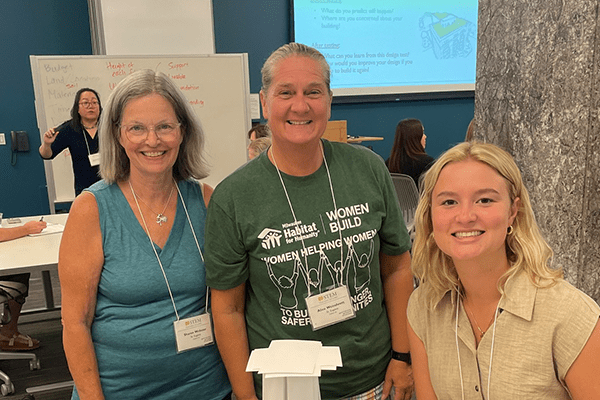
Sharon Webster, Alice Weinshrott and Sarah Mendelson, all STEM teachers at St. Eugene, Fox Point, attend a teaching fellowship program at Notre Dame University in South Bend, Indiana. (Submitted photo)
Three STEM teachers from a Fox Point Catholic school are receiving powerful tools and wisdom as educators selected as University of Notre Dame STEM Teaching Fellows.
St. Eugene’s Sarah Mendelson, Sharon Webster and Alice Weinshrott are learning deep, applicable lessons in how to help children take ownership of their learning in powerful ways and use it for a greater good while connecting with Catholic values.
“The three teachers, they’re outstanding to begin with, and the fact that they wanted to go on this journey says a lot about them,” said St. Eugene Principal Rebecca Jones. “We couldn’t be more proud. It’s so much fun to see how invigorated they are.”
Groups of educators were selected from just eight schools around the country to join the program, which has been offered for the past eight years. The teachers are now among more than 200 educators who have received two weeks of tutelage from the Catholic university in South Bend, Indiana, and are continuing with follow-up education.
“It’s been amazing,” said Webster, who is St. Eugene’s STEAM director and an algebra teacher. “It is the best professional development I’ve had in my almost 40 years of teaching. It is so on target with kids’ needs.”
The program immersed the three teachers on the Notre Dame campus for two weeks of learning last summer. Follow-up sessions included a four-day gathering in Texas last month. Principals of selected teachers, including Jones, will join their teachers at Notre Dame for part of the upcoming summer development sessions.
Those sessions not only focus on math, science and engineering teaching methods, but integrating them into connecting core values.
“You can tell these values are very important to Notre Dame, doing things for the good of humanity,” Webster said.
“Another common theme is to look at everything through an ‘asset lens’ — a key phrase that we heard over and over again — to always look at students in a positive way, and to see their best values.”
Jones and Webster add that part of what makes the program powerful is the experience of being recorded while teaching and having mentor coaches offer feedback.
“They all have had to be vulnerable because they have to videotape themselves teaching, but the benefits of allowing other people to critique what they’re doing are just worth it,” said Jones. “They recognize that sometimes you have to be vulnerable, so they can feel what it’s like to be a student again, and that makes them better teachers.”
“We were expected to be able to practice these things on each other, so it was a lot,” Webster said. “They were long days, and yet at the end of the day, we felt invigorated. We felt energized.”
Weinshrott, who teaches grades 6-8 math and religion, credits Notre Dame’s program with helping her pivot her philosophy from one of pedagogy to a role of facilitating students’ collaborative learning.
“It’s shifting my classroom focus from simply identifying correct and incorrect answers to truly understanding student thinking,” she said.
“Through coaching cycles and collaboration with other fellows, I have learned how powerful open-ended questions, revoicing, pressing for reasoning and inviting peer responses can be in making student ideas central to learning. Rather than rushing to provide answers, I am learning to create space for students to explain their reasoning, listen to one another, respectfully disagree and view mistakes as an important part of the learning process.”
Mendelson, who teaches grades 6-8 science and social studies, has watched her students engage deeply with engineering projects to highlight real-world problem-solving.
“Students can develop solutions to help others — whether it’s designing flood prevention models for areas prone to flooding, creating ancient irrigation systems, or designing a thermos that insulates heat as the temperatures begin to drop,” she said.
“Through these experiences, students learn that their skills can be a force for social justice and an expression of their faith.”
Jones says the difference in these three teachers’ philosophies and methods of teaching is spreading to the entire school community and improving students’ experiences.
“It trickles to the rest of the faculty. It trickles down to the students and to the families,” she said. “This initial year, they’re doing a lot of implementing things in the classroom. They’ve started to give some professional development to the rest of the staff. Next year, they’ll be doing even more of that.”
All of this growth in philosophy of education is meant to help each student understand the potential God gave them and catalyze it within their lives.
“I hope to show every student that they are capable of making a positive impact on the world, answering God’s call to love and serve our neighbors,” said Mendelson.
As Webster said, “It’s amazing, and it’s inspiring.”
