
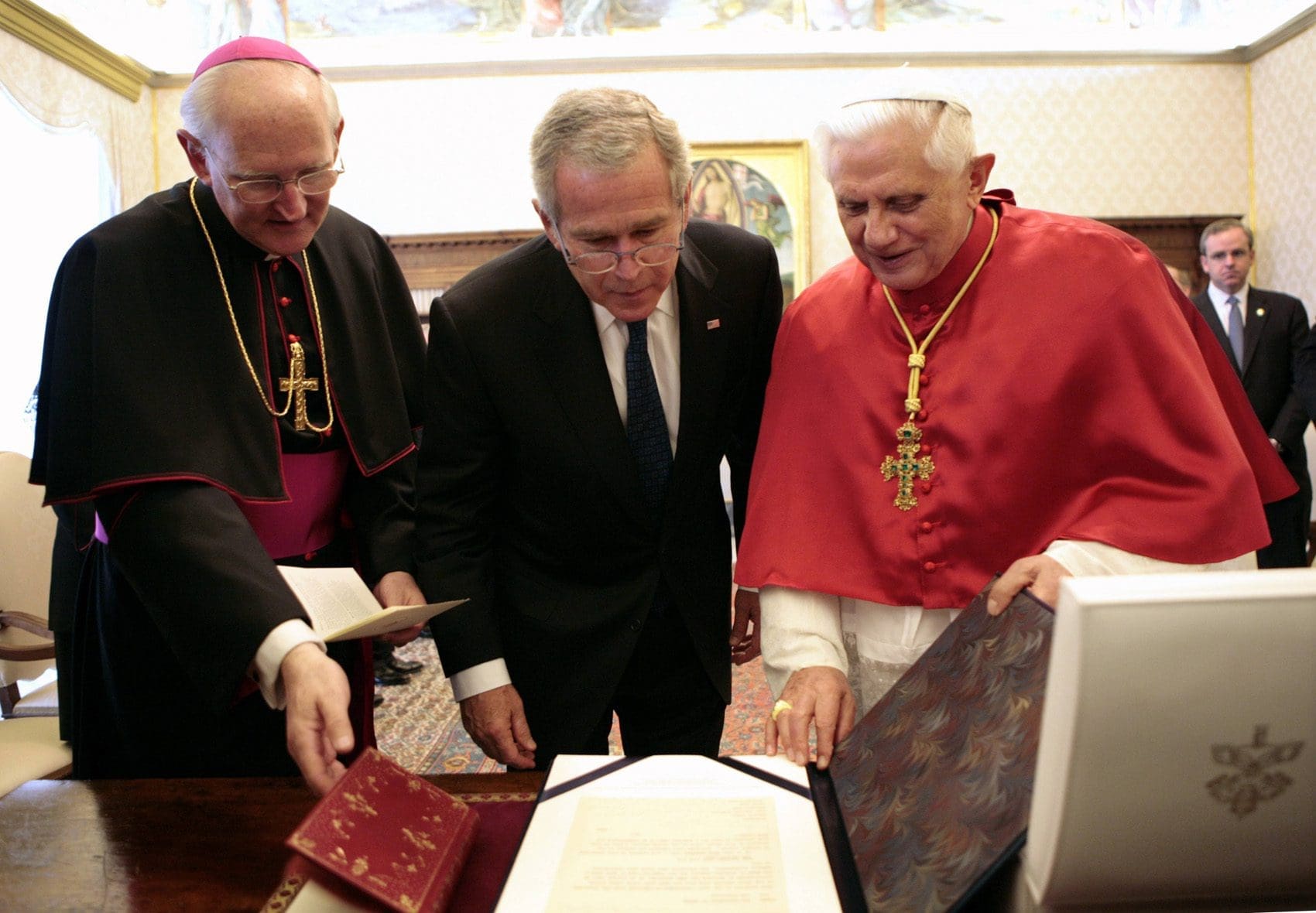
Cardinal James M. Harvey worked closely with Pope Benedict XVI for many years, including in meetings with many world leaders such as President George W. Bush. (CNS photo)
Cardinal James M. Harvey probably knew Pope Leo XIV when he was Cardinal Robert Prevost about as well as any American cardinal before the May conclave that elected the first pope from the United States.
As the only two U.S. natives on the Vatican Dicastery for Bishops, Cardinal Harvey said he was naturally drawn to Cardinal Prevost.
“I could see why, given his personality, he was something of a magnet,” Cardinal Harvey said of the previously little-known Chicago native, who was elected in a quicker-than-expected conclave.
Cardinal Timothy Dolan, who served as Milwaukee’s archbishop from 2002 to 2009, told New York news stations in the days after the conclave that many American cardinals knew little about Cardinal Prevost, but many cardinals from across the globe were asking about the man who would eventually become pontiff.
“He was very matter of fact, very unassuming,” Cardinal Harvey said of Pope Leo. “He was not shy, but he didn’t want to impose himself. People tend to trust him.”
For Cardinal Harvey, the election of Pope Leo XIV in May was the second time he had participated in a conclave.
He was named a cardinal a few months before Pope Benedict XVI retired in early 2013 and so was among those who elected Pope Francis in March 2013.
One of the things Cardinal Harvey noted his brother cardinals wanted to continue with the next pope was Pope Francis’ emphasis on being a missionary Church that goes out to the peripheries.
“I think (experience as a missionary) was a plus for someone that was going to be chosen,” Cardinal Harvey said. “Another thing I think was important was that you wanted someone who had shown a proven track record of good governance skills.”
Pope Leo XIV’s work for decades in Peru as a missionary, in addition to his time as Superior General of the Augustinians, gave him two big pluses when the cardinals gathered to deliberate.
Cardinal Prevost’s nationality ended up being blurred by those two huge positives of his background. Some had presumed there wouldn’t be an American pope any time soon, but Cardinal Harvey said that got buried under his qualifications, personality and magnetism.
Heading into the conclave, there was speculation the process might be longer than usual because many of the cardinals that Pope Francis had appointed hadn’t even met one another yet.
Cardinal Harvey said the cardinals were prepared for the long haul, but Pope Leo’s personality and qualifications allowed him and his brother cardinals to coalesce around the new pope rather quickly.
“His personality lent itself to him being electable,” Cardinal Harvey said.
Archpriest at St. Paul Outside the Walls
Cardinal Harvey served as the prefect of the papal household for St. John Paul II and Pope Benedict XIV from 1998 until the latter named him a cardinal and appointed Cardinal Harvey as archpriest of St. Paul Outside the Walls, one of the four major basilicas in Rome, in November 2012, just months before Pope Benedict retired.
He has served in that role since.
Cardinal Harvey oversees the whole operation of the basilica, including pastoral life, personnel, staffing, Masses and other activities.
“It’s a beautiful opportunity to pray at the tomb of St. Paul every day,” Cardinal Harvey said.
Unique to the basilica he administers, Cardinal Harvey said, is the fact there is a community of Benedictine monks who have been taking care of the basilica, welcoming visitors and guarding the tomb of St. Paul since 726 A.D. The monks also serve as confessors for the pilgrims who visit the basilica. Cardinal Harvey said they cumulatively hear about 60 hours of confessions a week.
Cardinal Harvey says Mass for a series of major feasts during the year, and is available when asked by a smaller group, such as when pilgrims from his hometown visit Rome.
St. John XXIII announced his intention to call the Second Vatican Council on his first visit as pope to this basilica in 1959. A priority of that council was ecumenical relations, establishing dialogue with other Christian believers, both of the Orthodox Churches and the Christians of the reformed traditions. This basilica has been a locus of many ecumenical events over the years.
